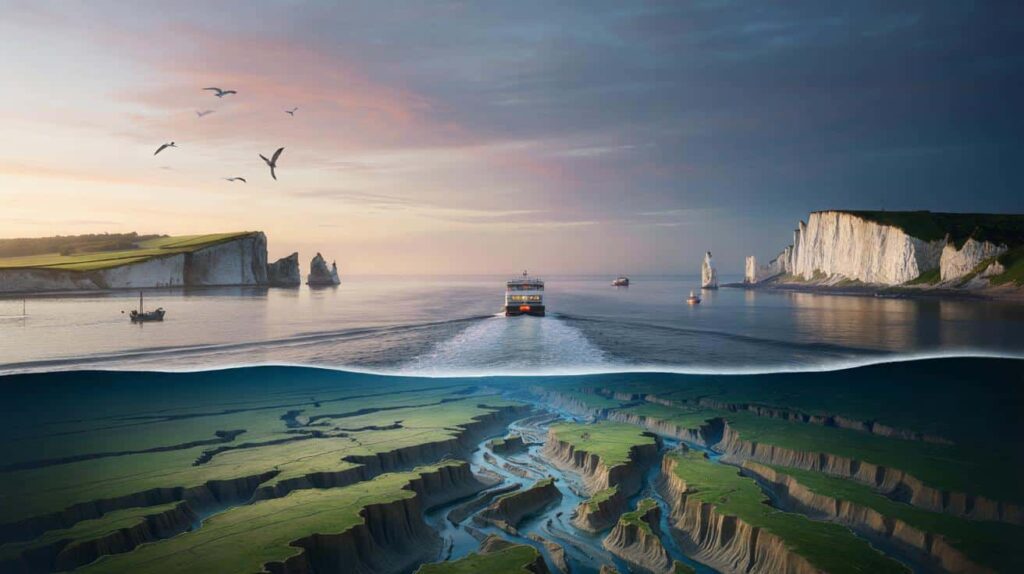
New scientific maps now reveal something surprising beneath the English Channel. Hidden under layers of mud and sand are ancient river paths showing that the Thames, Seine, and Rhine once flowed across the same landscape. These rivers met in wide valleys and floodplains long before the sea covered the region. The discovery quietly changes one of the most familiar ideas in European geography—Britain was not always an island.
At sunrise on a ferry crossing toward Calais, the surface of the Channel appears calm and ordinary. Currents slide over one another like smooth ribbons, while the chalk cliffs of England slowly disappear behind the horizon. Fishing boats move across the water and sonar instruments scan the seabed below, sending signals through layers of silt and stone. At first, the water seems silent, but when scientists learn to interpret these signals, the seabed begins to tell a very old story.
Inside the ferry cabin, charts and digital maps cover the tables. Each vibration from the engines makes the coffee cups tremble slightly. A researcher traces a finger along pale blue lines on a bathymetric map that outlines a valley hidden beneath the sea. It is a valley that has not seen daylight for thousands of years. In that moment, it almost feels as if the ancient river beneath the Channel is still breathing. The Channel, it turns out, is not only a sea—it is a geological memory.

Ghost Rivers Beneath the English Channel
Recent seabed mapping combines hundreds of high-resolution sonar and seismic surveys to create one of the most detailed images ever produced of the Channel floor. What appears in these maps is a vast network of buried valleys, terraces, and channels. Together they form what scientists describe as a massive “super-river system” that once flowed west toward the Atlantic Ocean.
 How to create the viral "glass hair" finish at home: from smoothing shampoos to shiny serums
During periods when global sea levels were much lower—especially around 20,000 years ago during the last Ice Age—the seabed between Britain and France was dry land. Instead of a sea separating the two regions, there was a broad plain crossed by powerful rivers. The Thames flowed south from Britain while the Seine and Somme approached from France. From the east came the Meuse and Rhine. These rivers eventually joined together and carved large valleys across the landscape.
The sonar images show ridges and branching channels that resemble fingerprints across the seabed. These patterns reveal how the rivers split, merged, and shifted over time as water carved through rock and sediment. The floodplain that once carried these rivers is now buried beneath the waves, while ferries travel above paths once used by animals, early humans, and migrating herds.
Eventually the environment changed dramatically. As the Ice Age ended, glaciers melted and global sea levels rose. The valleys filled with water and the landscape slowly drowned. Some geological evidence suggests that enormous floods also played a role in opening the Dover Strait. A chalk ridge that once connected Britain to mainland Europe may have collapsed during catastrophic flooding, allowing the sea to rush in and permanently reshape the coastline.
Learning to Read the Hidden Landscape
Understanding these ancient rivers requires learning how to interpret the language of seabed maps. Bathymetric charts display shallow areas using warmer colors while deeper cuts appear in cooler shades of blue. Steep slopes are marked by tightly packed contour lines, revealing the walls of submerged valleys.
Scientists often combine these maps with seismic profiles—cross-sections that show the layers buried beneath the seabed. These grey images look almost like pages of a book, with each layer representing a different moment in geological time. Within them researchers can identify riverbanks, sediment deposits, and the sharp edges left behind by powerful floods.
However, interpreting these images requires caution. Not every mark on the seabed represents an ancient river. Modern human activity—such as trawling or underwater cables—can leave straight, mechanical scars that might be mistaken for natural features. Looking too closely at noisy data can also create misleading patterns. Researchers must keep both realities in mind: the modern sea above and the fossil landscape hidden below.
 4 evening yoga poses designed to release tight hips and ease tension after long sedentary days
When the pieces finally fit together, the maps reveal how valleys formed, how sediments moved, and where sand still drifts across the seabed during strong tides. The Channel begins to feel less like an empty stretch of water and more like a layered archive of natural history.
Rewriting the Story of Britain as an Island
This discovery does not change modern borders or the daily movement of ships across the Channel. What it changes is the timeline of the region. Long before coastlines and passports existed, there was a shared corridor of land connecting Britain to continental Europe. Herds of animals migrated across it, early humans likely traveled through it, and rivers carried sediments across the landscape.
The ancient river system also helps explain several modern geological mysteries. It clarifies why certain minerals and flint deposits appear where they do, why some harbors collect silt more quickly than others, and why shipwrecks often accumulate in particular tidal zones. The hidden rivers continue to influence how water and sediment move through the Channel today.
As sea levels slowly rise again due to climate change, the Channel also serves as a reminder that coastlines are never permanent. Landscapes that once supported forests, animals, and human movement can transform into seabeds over time. What is now a strait was once a pathway.
The Memory Beneath the Waves
Anyone standing on the cliffs of Kent or along the French coast near Pas-de-Calais can watch ferries cross the narrow stretch of water between the two countries. The route looks like a straight line across the sea, yet beneath those waves lies the memory of an ancient landscape.
Long ago, the Thames and the Seine flowed toward each other across that land before joining a larger river system heading west. Today their meeting place is hidden beneath layers of water and sediment. The Channel still carries the faint pulse of those rivers, softened by thousands of years of tides and salt.

Once people learn about the story hidden below the surface, the sea never looks quite the same again.