A woman in her forties stops in the middle of dyeing her hair on a Tuesday morning in the harsh light of a bathroom mirror. Her roots are back. Again. The towel is slipping, the phone is ringing, and the room smells like ammonia. She lets out a sigh. She knows she will be back here in three weeks maybe sooner. Same routine, same spot on the sink and the same quiet panic every time a new grey hair shows up.
But on her feed, she sees another picture women with shiny, blended grey hair that doesn’t have a harsh line or a shoe polish colour. Their hair looks soft bright and strangely young. Younger than her bob that was fully dyed. As she stares at the dripping brush over the bin, she has a thought.
What if the secret to looking young in the future was not dyeing at all?

How to hide grey hair without dyeing it
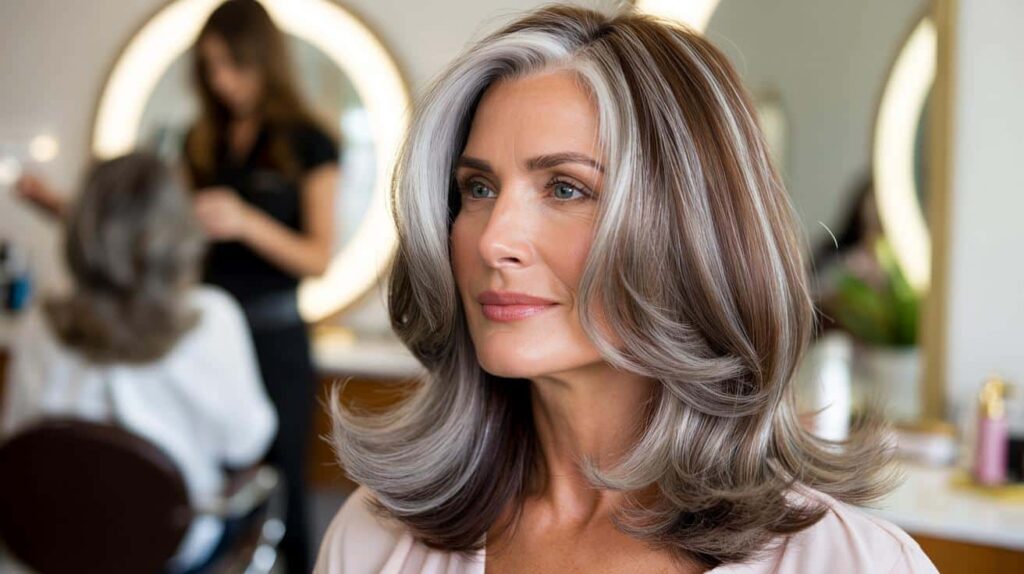
It’s not about hiding our grey hair anymore. It’s about mixing it so well that you don’t notice it right away. Colourists call it grey blending low-maintenance coverage, or no dye illusion. It’s slowly taking the place of the old full coverage dye jobs.

The hair is worked in very fine contrasts instead of one flat colour from roots to ends. The natural colour the lighter strands, and the grey weave together so that the eye can’t tell where one begins and the other ends. It looks soft and bright, like a filter in real life.
You still look like yourself. Just look like yourself. Just relaxed.
You can see it on Instagram or TikTok: brunettes with silvered temples and blondes with pearl-like highlights that make their grey hair look like it has no colour. Their hair moves and catches the light, and it doesn’t have that one block colour that says fresh dye.
A salon in London recently released its numbers: demand for no dye grey blending services has risen by more than 60 percent in the past two years, especially among women aged 38 to 52. This is also happening in Seoul Milan and New York. There is grey, but the overall effect is still young and active.
A French colourist even joked, my clients don’t want to lie about their age anymore. They only want their age to look good on them.
What happened? The obsession has changed from I must hide every grey to I want hair that looks expensive and easy. Dark solid blocks of colour make features look sharper and stand out against the scalp and skin. That can really add years especially as the skin on the face gets softer over time.
On the other hand, blended grey works like natural contouring. The lighter strands around the face make the skin look brighter, make shadows less harsh, and draw attention to the eyes instead of the roots. The grey is technically still there, yet visually downgraded to a background texture.
It’s more of a smart optical trick than a moral stance.
How the new methods work, from dye bottle to blending brush
The first important sign of this trend is doing less colourists. Colourists don’t dye every strand; instead, they work with small sections they keep your natural base and add very thin highlights and lowlights to the parts of your hair where grey is most visible, like the parting temples and contour of the face.
When you have dark hair, they often lighten the base by one or two tones to make the grey less noticeable. Then they add cool caramel ash or mushroom tones that grab the grey and make it look like it was meant to be there. When it comes to blondes, the trick is often to make them a little creamier and pearly.
One session can last longer than a normal dye job. But the grow out is hard to see.
Think about how often you dye your roots. There is always a sharp white line along your hairline and parting. The constant battle line is what ages the most. That line doesn’t look as bad when you use grey blending techniques.
You might have to wait eight ten or even twelve weeks between appointments because the hair has been coloured in patches and spread out. The grey that comes in just looks like a different shade. A woman in her fifties told her stylist, for the first time in fifteen years, I don’t panic when I tie my hair up.
You can see that freedom on your face. People see that first, then they see the hair.
There is also a psychological side to this. Your brain stops looking for intruders slowly when you stop fully covering. The silver is no longer a warning sign; it becomes part of the palette. The trend is based on two strong visual effects: shine and softness. Permanent dyes can make hair look thick but stiff. Blending usually uses softer methods toners and partial lightening that keep the texture.
 Salon-style eyebrows at home – 7 simple steps that create perfectly defined brows naturally
What happened? Movement, thinking, and the halo areas around the face that make you look younger. What really makes us look younger is not a fake age, but energy in the hair and ease in the way we move.
That’s why so many people say they look younger with a little grey showing than with colour that is too dark and stiff.
How to begin: a realistic plan to stop using full dye
The best way to stop dyeing is not to do it all at once, but to talk to a professional about a transition roadmap. Bring pictures of women with hair colour and style you like, not just hair colour. They should be close to your age and hair type. That’s your board of ideas.
If you’ve been using very dark box dyes, ask your colourist to slowly lighten your base tone over the course of two or three sessions. Then, where you’re the greyest, usually at the front and crown, add highlights that are spaced out well. The first session’s goal is not to be perfect.
The real goal is to break the harsh root line so that you can go a month or two between touch-ups.
A lot of people fail at this change because they think one appointment will fix everything. They come in with years of black dye on their weak hair and hope to leave looking like a silver person on Instagram. The hair just can’t handle it.
You might go through a time when your colour feels in between a little softer, more varied, and maybe not as shiny as your usual solid dye. That’s normal. It’s like growing out a fringe: at first it’s awkward, but then it all makes sense.
Let’s be real: no one really does this every day with masks, serums, and scalp massages. So let yourself go through a messy bun phase.
It’s easier to stay on track if you focus on a few simple habits instead of a lot of products. Consider:
- To keep reflected tones fresh, pick a shampoo that doesn’t have sulphates and is safe for colour.
- If your grey hair picks up yellow or brass, use a light purple or blue shampoo once a week.
- Cutting off the dry, over-dyed ends little by little so that the natural texture can come back.
- To dilute grey, wear softer partings and a little more volume at the roots.
- Instead of getting full root coverage, get a gloss or toner every few months.
Each small change helps the bigger change away from permanent, all-over colour.
When grey stops being your enemy and starts being your friend
There is a time during this journey when things are quiet. You see your own reflection in a shop window or a lift one day, but you don’t immediately look at your roots. Instead, you notice your jawline the curve of your neck above your collar, or your eyes. The hair is no longer yelling.
Without knowing it, your friends start saying, you’ve changed something you look fresher. You spend less time with gloves on and more time doing something else. The mirror isn’t a battlefield anymore it is just a quick check before you leave.
This doesn’t mean that everyone has to stop colouring or that full coverage is suddenly bad. Some people love that smooth consistent look and feel like they can’t live without it. Some people flirt with blending, but then they go back to classic dye for a while. The trend isn’t a rule; it’s just one more choice on the menu.
The new thing is that grey can now be on your side. Instead of shouting your age, it can quietly shape your haircut, frame your face, and give you that modern lived in sophistication that no bottle ever really managed to give you.
You might talk about it with a friend over coffee, and both of you might lean in to look at the other’s hairline with guilty interest today. You compare your roots, your plans, and the little times you freak out before a big event. Underneath all of this is the same question how do I want to look in the mirror as I get older?
Not how do I get rid of the years but how do I want to see myself every day?

The new trend of not dyeing your hair doesn’t promise to keep you young forever. It promises a version of you where the grey hairs are there, but they’re wrapped in light, movement, and a little more peace.
 Goodbye angled bob: Anti-ageing haircut restores volume and softness to thinning hair after age 55
| Important point | Value for the reader |
|---|---|
| Grey blending vs. full coverage Partial, nuanced colour that hides harsh root lines instead of all of the grey | Looks younger with less work and more natural movement |
| Strategy for the transition Base colour that gets softer over time, micro-highlights, and longer gaps between appointments | Lessens stress, damage, and cost while avoiding the two-tone stage |
| New way of thinking Grey is a texture to work with, not a flaw to get rid of. | This boosts your self-esteem and makes daily hair care feel lighter and more purposeful. |