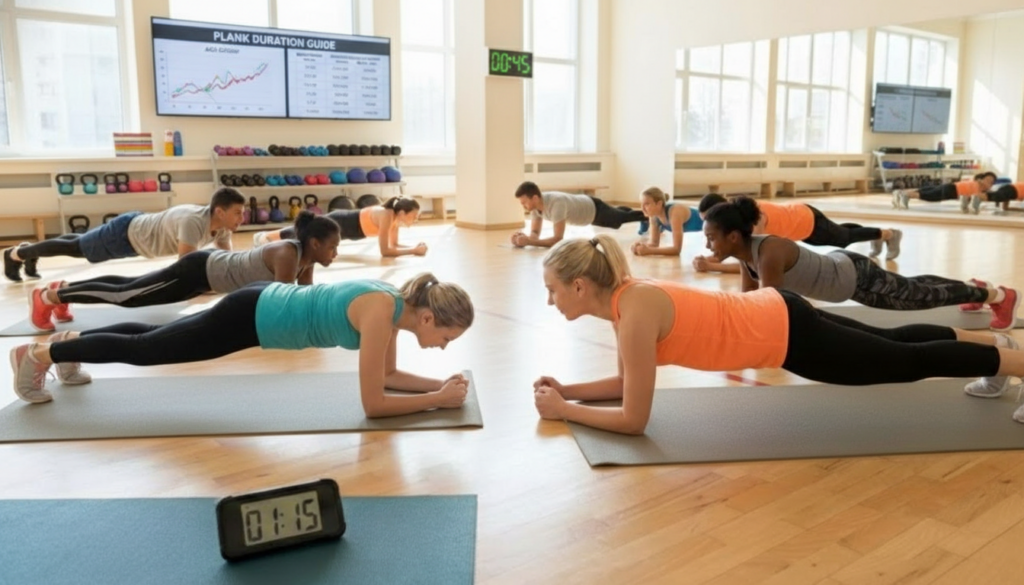
Your forearms feel cool against the floor. Your breathing slows, your legs are working, and your toes are gripping the mat. Your mind is clear and your core is tight, so you may be asking yourself, “How long should I hold this plank?” Ten seconds? Thirty? Two minutes that seem to go on forever? There are various sizes of planks. They are constantly changing due to gravity and your body as you age. At 18, you might feel powerful, but at 48, it might be difficult, and at 68, it might require more attention. Your core is the most vital part of your body, regardless of your age. It allows you to move around, supports your spine, and shields your back. To determine how long the ideal plank should last, you must be aware of your current physical condition.
How to Time a Hold of a Plank
The Quiet Power Within
Unlike heavy-weight exercises or foot collisions, planks don’t make noise. With your shoulders stacked on top of your elbows or wrists and your head floating naturally, your body forms a long line. Your heels extend backward. It appears simple from the outside. However, an internal quiet storm starts. The diaphragm links breathing to effort, the pelvic floor provides stable support from below, the multifidus shields the spine, and the transverse abdominis tightens like a belt to support the body. When these muscles are repeatedly worked out calmly and steadily, they perform at their best.
This implies that length is not as important as quality. A clean twenty-second hold performed with proper alignment and control is more beneficial and safer than a tense, collapsing one-minute plank. It’s crucial to continue, but you should stop when your form begins to falter rather than when you’re hurting.

You Should Know About Long Planks
Extremes like two-minute holds, five-minute challenges, and viral videos of people shaking their bodies and persevering are frequently praised in fitness culture. It’s actually quieter. Holding a plank for extended periods of time eventually increases your pain tolerance rather than your strength. Research and experts concur that frequent short precise holds are more beneficial to your spinal health and core strength than occasional long, intense workouts.
Long planks are not unhealthy, but they are less beneficial and increase the likelihood that you will lose alignment when you’re exhausted. “How long can I last?” is replaced by “How well can I help my body now?”
The Pull of Gravity, Age, and the Plank Equation
The body reacts differently as we get older. Tissues become stiffer, heal more slowly, and require more effort to maintain your balance. Planking used to be simple, but it may now require some effort. That’s not weakness; that’s biology. Instead of adhering to a single rule, it’s preferable to follow flexible ranges that consider your shape and ability.
Age appropriate hold times for planks:

| Age Group | Suggested Frequency of Time |
|---|---|
| Adolescents (13–19) | 20–40 seconds, 2–4 sets, 2–4 days per week |
| 20s and 30s | 30–60 seconds 2–4 sets, 3–5 days a week |
| 40s | 20–45 seconds 2–4 sets, 3–4 days a week |
| 50s | 15–40 seconds |
| 60s and 70s | 10–30 seconds 2–4 times a week |
These ranges are merely suggestions, not regulations. The quality of each second you hold is the most crucial factor.
Unwavering strength
Individuals in this age range have strong tissues, heal quickly, and naturally gain strength. The ideal duration is typically between thirty and sixty seconds. The greatest risks are minor issues like lower back pain, hips dropping, or shoulders creeping. Doing it in multiple shorter controlled holds is preferable to attempting to do it all at once.
Strong but conscious in your 40s
Your body communicates with you more effectively by the time you are forty. Tightness, stiffness, and old injuries occur more rapidly. These days, the most effective holds are repeated several times and last between 20 and 45 seconds. On some days, it’s better to stop sooner, and on others, you can wait longer. The emphasis switches to improving posture and maintaining it over time.
In your 50s, 60s, and beyond: Be resilient rather than reckless.
In the coming years, we must rethink our conception of strength. Even though they lose muscle mass, alter balance, and require more time to heal, planks are still beneficial. Short holds of 10 to 30 seconds that are perfectly aligned can be quite effective. Good variations on the original are knee or incline planks. You stay upright, stable, and confident in your movement with every well supported second.
Knowing when to stop
Your body is warning you that a plank is too risky if your face strains, your shoulders tense, or your lower back sags. You’re not giving up if you quit as soon as you notice a loss of form; rather, you’re training wisely and improving the function of your nervous system and preventing it from deteriorating over time.
 Rice water hair rinse trend shows visible hair growth improvements for many women within 14 days