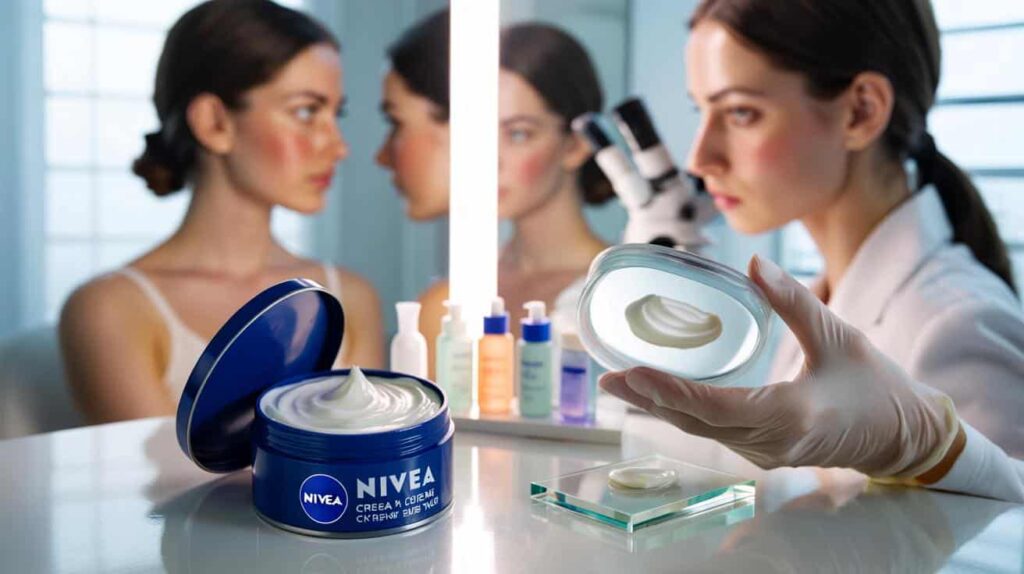
You probably know the sound of the blue metal tin clicking open on the dermatologist’s desk. The small, bright office smelt like clean soap and whipped cream. Under a magnifying lamp, a product you had seen in your grandmother’s bathroom, in your gym bag or at the airport duty-free shop suddenly looked very strange.
As if it were a science show, the expert put some Nivea cream on a glass slide and began to explain what was really in that thick white formula. The stuff you put on your skin without thinking about it when it feels tight.
The room felt different after five minutes.
You can’t un-hear what someone says after they calmly pick apart your favourite cream.
 Goodbye hair dyes : the new trend that covers grey hair and helps you look younger emerging
What professionals really see when they look at a tin of Nivea cream
Dermatologists and cosmetic chemists don’t see nostalgia in a tin when they look at classic Nivea cream. They see a water-in-oil emulsion that was new 100 years ago. It has a lot of occlusives like petrolatum and paraffin, as well as glycerin and a few stabilisers.
That means that on the skin, it forms a thick, almost waxy film that keeps water in like cling film does on food. That’s great for skin that is very dry or in freezing wind. It can feel like a winter coat in July on skin that is prone to acne or too hot.
The funny thing is? Most people don’t see the connection between that blue tin and their little bumps or dull, suffocated glow.
One cosmetic chemist I talked to has a stack of regular creams in her lab. The Nivea tin is always on top because so many patients talk about it when they come in for an appointment. A teacher who is 52 years old told her she has used it as a night cream “since forever.” She liked how comfortable it was, but she hated the blackheads on her cheeks.
Her skin changed in three weeks after they switched her to a lighter, non-comedogenic moisturiser and only used Nivea on her hands and legs. Not magic. It was just basic chemistry that no one had ever told her about.
The numbers back it up: surveys in European clinics show that a lot of people use body-type occlusive creams on their face, either out of habit or because ‘Mom always did’.
The story is easy to understand from a scientific point of view. Classic Nivea is made to sit on top of the skin and keep water in. It doesn’t really bring in meaningful amounts of targeted actives like niacinamide, peptides, or stabilised vitamin C. It’s not a treatment, it’s comfort.
That thick texture makes it harder for your skin to breathe and get rid of dead cells. That can be soothing for some skin types. It can also make pores more likely to clog, especially when put on top of heavy sunscreen or full-coverage foundation.
When experts look at Nivea, they don’t say it’s “bad.” They say it’s old-school and deeply context-dependent.
How to use Nivea cream without hurting your skin
Experts say the first thing you should do is very simple: choose what you want Nivea to do. Hand saver? Fixing the heel? Barrier to wind for skiing? Or face cream all the time? The risk/benefit story is different for each choice.
A lot of dermatologists now say to treat it like a tool that is meant for a specific purpose. Apply that thick, blocking power to body parts that really need a barrier, like cracked knuckles, chapped lips (in a pinch), and shins that look like chalk.

They usually only keep it for very bad situations on their faces. Think about winter hikes, the dryness that comes after using retinoids, or that one cold morning when your cheeks are burning. Not every night, 365 days a year.
We’ve all been there: when your skin feels so tight that you just grab the richest thing you can find and put it on. Then you wake up shiny and think, “hydrated,” but you’re really just covered.
Dermatologists say that people wash their faces poorly, put on layer after layer of actives, feel irritation, and then cover it all up with Nivea in the hopes of “resetting” their skin. The soothing film works for a day or two. Then the breakouts come, slowly and almost politely.
To be honest, no one really does this every day. But putting on a heavy occlusive as an emotional bandage after every mistake in your skin care is a sneaky trap. Your skin never gets to breathe or find its own beat.
During a conference, a dermatologist from London said it plainly: “Nivea cream isn’t the bad guy. The real problem is using a formula that is over a hundred years old in a skincare world in 2026.
- Use it in your area
Think of your elbows, feet, hands, and cheeks that are windburned. Small areas, short times.
- Put it with actives
First, let your treatment serum (like niacinamide or retinol) soak in. Then, put a pea-sized amount of Nivea on the dry spots.
- Don’t put a full coat on your face every day.
This is especially true if you have oily skin, are prone to acne, or live in a hot, humid area.
- Respect your step of cleaning
If you wear makeup and SPF under Nivea, you should double cleanse at night or stick to lighter textures.
- Pay attention to what your skin says.
If you notice more blackheads, milia, or redness, lower Nivea to a “body-only” product.
What this blue tin tells you about your entire skincare routine
Once experts start to open up Nivea, the conversation quickly grows. That little tin is a reflection of how we usually take care of our skin: with habits, memories, advertising, and a little bit of hope. A lot of people think that one cream can fix dryness, wrinkles, rough skin, and sensitivity because it’s cheap and they know it works.
The truth is that Nivea was never meant to solve the problems that our modern lives cause. Blue light, pollution in cities, too much exfoliation from trendy acids, and high-strength retinoids are all different problems.

You have a choice now. You can keep using it as a general answer, or you can give it a specific job and make a routine that fits it better. Not more difficult. Just more purposeful.
 Martin Lewis urges UK households : do you have the £82 power of attorney before 17 November
What the reader gets out of it
| Main point | Detail: What the reader gets out of it |
|---|---|
| Know what Nivea really does: it’s an old-school barrier cream with few active ingredients. | Keeps you from expecting anti-aging or acne benefits that it can’t give you |
| Use it wisely, not without thinking. Save it for dry spots, bad weather, or after irritation to feel better. | Enjoy the good side (protection) while getting rid of dullness and clogged pores. |
| Change the rest of your routine | Add lighter, more focused products to your daily face care routine. Without giving up old favourites, it makes results better, skin clearer, and healthier in the long run. |