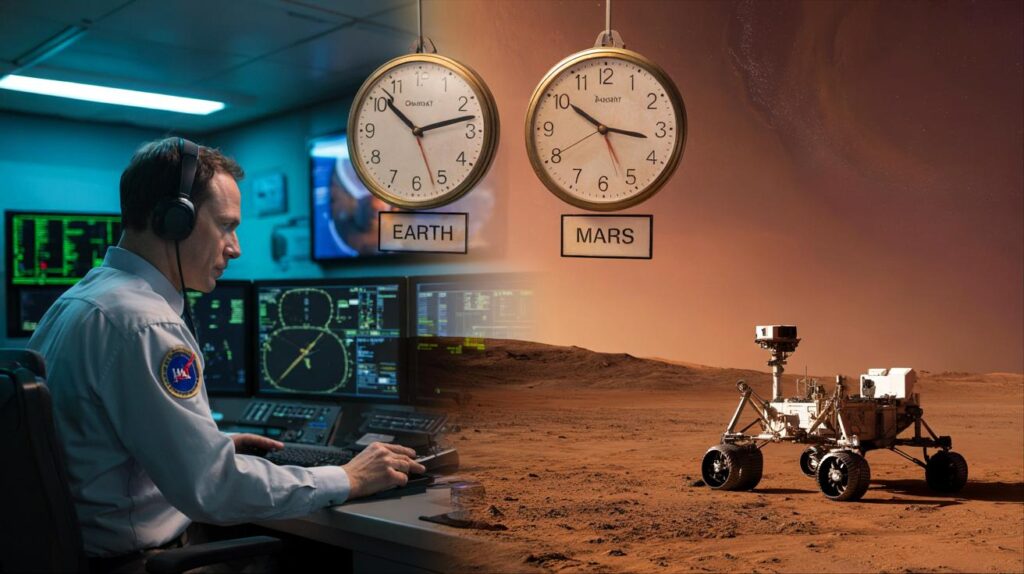
At NASA’s Jet Propulsion Laboratory in Pasadena, a technician watches two clocks mounted on the same wall. One shows Earth time. The other shows Mars time. The second hands move together, but the numbers never truly match. On his screen, fresh data from the Perseverance rover scrolls in, each timestamp slightly out of sync with what we on Earth would call “now.”
Every signal crossing millions of kilometers is shaped by distance, gravity, and motion. Engineers often have to send commands before an event even “happens” for them on Earth. What looks like a scheduling error is actually Einstein’s century-old equations quietly doing their job in deep space.
How Mars Quietly Stretches Time
If you look at Mars through a telescope, it seems calm and distant. But time there behaves differently. Not just because a Martian day — a sol — lasts about 24 hours and 39 minutes, but because gravity itself bends time.

Mars is smaller and lighter than Earth. According to general relativity, weaker gravity allows clocks to tick slightly faster. That means a clock sitting on the Martian surface will gain tiny fractions of time compared to one on Earth.

Add orbital speeds, planetary motion, and the vast space between the two worlds, and those tiny differences start to matter. Over days, they are invisible. Over years of robotic missions — landings, orbit corrections, communication windows — those microscopic drifts become critical engineering realities.
Mars doesn’t just have a longer day. It has its own tempo.
Designing Missions for a Different Clock
When rovers like Curiosity and Perseverance landed, mission teams did something unusual: they began living on Mars time. Their work shifts followed the 24-hour-39-minute sol. Bedtimes drifted. Breakfast sometimes happened at midnight. Life slid forward about 39 minutes each Earth day.
That was only the beginning.

Future Mars missions will likely operate with systems that live natively in Martian time. Instead of constantly translating from Earth time, onboard computers and navigation software may treat Mars as the primary reference. Engineers are already discussing the idea of a coordinated Martian time standard, supported by ultra-precise clocks orbiting the planet.
In practice, three layers of time may coexist:
• Local habitat time for daily routines
• Mission time for navigation and operations
• Earth reference time for communication and archives
Living in a Solar System of Elastic Time
Accepting that time is local — not universal — changes how we think. A future Mars settler could grow up with longer days and slightly faster-ticking clocks, yet experience life as completely normal. Meanwhile, family on Earth would measure “tomorrow” differently.
This isn’t only philosophical. Precise timing determines landing burns, communication delays, solar panel orientation, and even safety during spacewalks. A small miscalculation could mean the wrong thermal prediction at sunset or a mistimed descent maneuver.

Relativity, once an abstract theory, now shapes mission design and daily operations beyond Earth. As humanity prepares for deeper space exploration, we are learning that “now” is not a universal agreement — it’s a local condition shaped by gravity and motion.

| Concept | What It Means | Why It Matters |
|---|---|---|
| Gravitational Time Dilation | Weaker gravity on Mars allows clocks to tick slightly faster than on Earth | Creates measurable timing drift over long missions |
| Martian Sol | One Mars day equals about 24 hours 39 minutes | Forces mission teams to adjust work schedules |
| Signal Delay | Radio signals take minutes to travel between planets | Requires predictive command timing |
| Mission Time Layers | Local, mission, and Earth-based time systems operate together | Prevents operational and navigation errors |
| Future Mars Standard | Possible Coordinated Martian Time system | Supports long-term human presence on Mars |