The hairdresser clips the cape around your neck, tilts their head, and says, “So, what are we doing today?”
Your brain starts to scroll through Instagram: blunt bobs that only look good on poker-straight hair types, layered waves that turn into frizz and curtain fringe memories that looked great on someone else’s face but brought back memories of middle school.
You want something new, simple, and up-to-date. But you also know that your hair doesn’t always listen to you and won’t follow 15-minute styling guides every morning.
 The Summer I Turned Pretty: this is the haircut to ask your hairdresser for to get Belly’s look
That’s when a good stylist usually suggests the same, almost magical answer: “Have you thought about a long layered bob?” A cut that works whether your hair wakes up straight or decides to go wavy.

The long layered bob: the haircut that really does it all
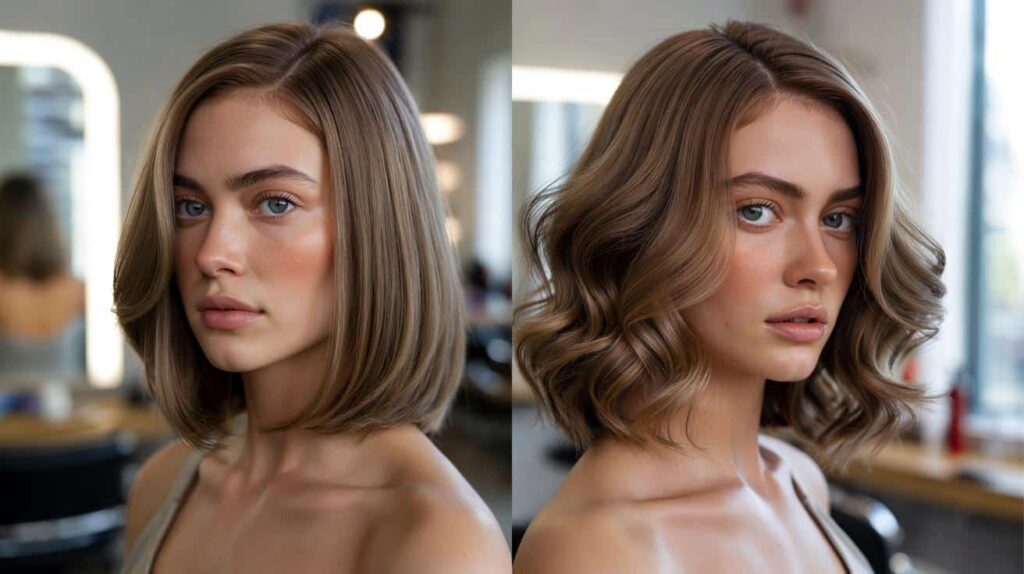
The long layered bob, also known as the “lob,” sits between the collarbones and the jawline. Not too short or too long; just the right length to swing, tuck behind your ear, or pull into a low tie on days when you’re in a hurry.
The lob looks clean and sharp on straight hair, with that “I tried but not too hard” vibe. The same cut looks relaxed and textured on wavy hair, like you just walked out of a sea breeze and into a meeting. One shape, two personalities, no problems.
Imagine this: Emma, who is 29, walks into a salon with thick, straight hair that always hangs flat. She leaves with a lob that goes down to her clavicle, some layers around her face, and soft layers on the back.
The next day, she lets it air dry and sees something she has never seen before: real waves forming. Not beachy curls like you see in commercials, but that imperfect bend that adds volume to the collarbones and cheeks.
She quickly straightens it for work that same week with a brush and dryer. It suddenly looks like a structured bob, almost like one from Paris, with the ends just touching her shoulders. Two styles, one cut, no regrets.
The lob can change shape easily because it has a good balance of weight and freedom. Shorter cuts can go against natural wave patterns, which can make hair puff out or kink awkwardly around the jaw. Long hair can pull waves down until they stretch out and disappear.
The long bob sits around the collarbone, giving waves enough room to form without adding too much weight. The length lets straight hair move and swing, so it doesn’t stick to the head like a helmet.
The secret is the discreet layering, which breaks up the heaviness without making the ends too thin. The same cut can look sleek one day and effortlessly wavy the next, depending on what you do after you shower.
How to ask for a lob and deal with it if you have straight or wavy hair
Words are important at the salon. You could end up with something too short, too blunt, or too round if you just say, “I want a bob.”
 Goodbye to the angled bob : the “anti-ageing” cut that restores volume to thinning hair after 55
Say things like “long bob at collarbone length,” “soft, invisible layers,” and “movement around the face.” Say that you want it to work with both straight and wavy hair, and that you don’t want to spend hours styling it.
Talk to your stylist about where your hair naturally flips at the ends. A good lob should be just above or below that flip point, never right on it. This way, you won’t get that stiff, triangle-shaped finish.
The lob is surprisingly forgiving at home, but it does have its traps. The biggest one is trying to style it like the models you see online, with perfect waves every day.
Let’s be honest: no one really does this every day. You don’t need a full blowout to make it look nice. A quick rough-dry with your head upside down already adds volume at the roots of straight hair.
People often make the mistake of attacking wavy hair with a towel and rubbing it like crazy. That stops the waves from forming in the first place. Instead, use a cotton T-shirt to gently squeeze the water out, then add a pea-sized amount of cream or light mousse and leave it alone.
The lob also enjoys little, easy-to-do rituals. One of the best ways to use it is to sleep with it loosely tied or clipped to the top of your head, like a very soft pineapple. You wake up with lift at the roots and fewer creases at the ends.
Another thing to think about is what finishing move to use: for straight hair, a drop of oil on the lengths; for wavy hair, a mist of sea-salt spray on damp mid-lengths. If you just push it in the right direction, the haircut does most of the work.
Camille, a stylist in Lyon, says, “People think there is a ‘straight hair cut’ and a ‘wavy hair cut.'” “Actually, the best modern cuts are a mix of different styles. The lob is one of them. It’s like giving hair two passports for travel.
- Request a lob that is collarbone-length and has soft, internal layers.
- When your hair is straight, use a round brush to dry it. When it’s wavy, use a diffuser or let it air dry.
- Use as few products as possible: one for shine or frizz and one for texture. That’s all you need.
- Every 8 to 10 weeks, make an appointment for a trim so the shape doesn’t fall apart.
- Try a part in the middle one day and a part on the side the next day to see what your hair wants to do.
Living with a lob: the calm assurance of a cut that “kind of” works every time
Having a haircut that doesn’t require you to make a personality choice every morning is a small relief. You can wake up with hair that is almost straight after a smooth night on the pillow, or hair that is half-dried and half-wavy after a late shower, and the lob will still look like you meant it.
*The way you feel about your hair changes more than just how you look. You don’t have to fight it; you can bargain with it. You stop worrying about “good hair days” and start accepting “good enough hair days” that still look like you.

You might change your style based on how you feel. For a meeting, it’s sleek; for a weekend brunch, it’s soft bends; and for a late train ride home, it’s tied low with loose strands. Same cut, different stories, and none of them need a tutorial to run in the background.

Main pointDetail: What the reader gets
| Main point | Detail: What the reader gets |
|---|---|
| Length around the collarbone | Keeps weight even and doesn’t make you look like a triangle or a flat. Works with the texture of things instead of against it |
| Soft, hidden layers | Makes the bulk lighter without making the ends too thin. Allows straight hair to move and wavy hair to bend naturally. |
| Simple ways to style your hair | One routine for smooth hair and one for wavy hair, both easy to do. Saves time, cuts down on frustration, and still looks planned. |