None of the three shades of brown in the woman’s hair were her own. She zoomed in on a selfie, sighed at the chemical odour from last week’s touch-up, and twisted a strand between her fingers. She could already see the grey halo surrounding her temples. Once more.
She froze after opening Instagram “just for a second.” It’s a normal-looking woman her age laughing in the sun, not some glitzy influencer. Her hair? Gentle, glowing, and yes, tinged with grey. She appeared younger than all the overdyed heads in the salon, for some reason.
The silent revolution on our minds: going from hiding to blending
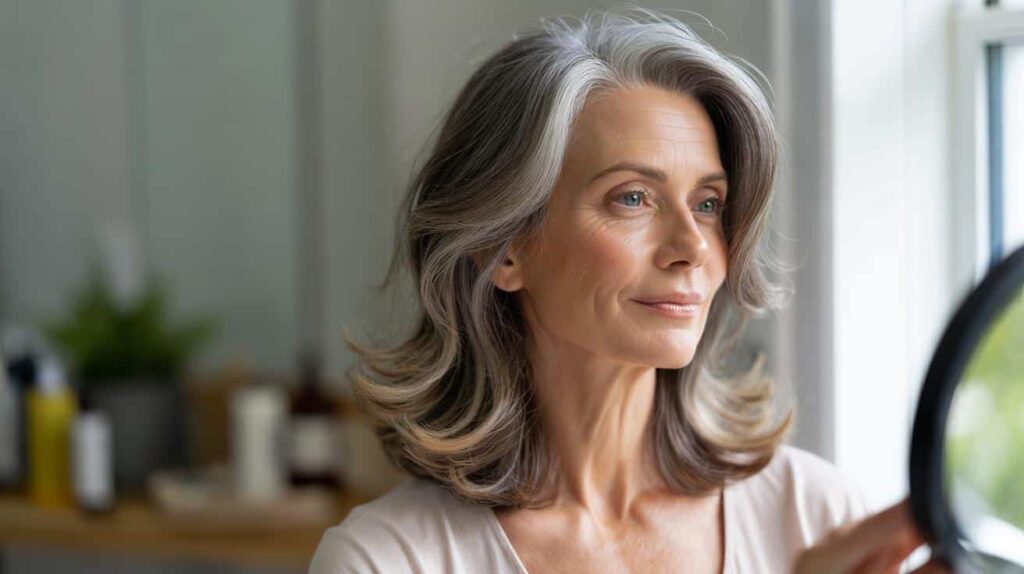
If you look closely, you can see it while strolling down any city street. There will be fewer helmet-like dye jobs and more hair with light, shadows, depth, and faint silver stripes. The old practice of complete, flat coverage is beginning to give way to what colourists refer to as “grey blending.”
The concept is straightforward: you work with each white hair rather than painting over them. You allow the grey to become a part of the hairstyle, melt various tones together, and soften the contrast. “I just spent three hours at the salon” is not the obvious outcome. “This is just my hair right now,” it murmurs.
They tried something new last spring. A few of her natural greys are still visible, with a slightly cooler tone at the roots and delicate sandy highlights surrounding her face. Three months later, she returned for a “refresh rather than” an urgent cover-up. Her regrowth? practically undetectable. She no longer kept a dye kit in her bag “just in case.” That small change altered her approach to scheduling dates, vacations, and even meetings at work.
This trend feels so liberating for a reason. Like dust on a black coat, flat homogeneous dye makes every new grey a sharp contrast. The flaw immediately catches your attention. That pattern is broken by blending. New silver hair strands add to the existing chorus of light and shadow in the hair’s various tones.
Something shifts in the mind. Grey is no longer “losing the battle” with you. You’re adapting, much like you would with a new hairstyle or lipstick. Strangely, the entire face appears softer, more youthful, and even slightly mischievous when there is less focus on concealing ageing.
How real hair actually responds to the new “youth effect” trend
This method’s magic lies not in a miraculous product but rather in a few exact movements the majority of colourists begin by making some of your hair a shade lighter than your natural colour, particularly around your face and parting. In this manner, your grey doesn’t stand out on its own. It fits in with a family of paler hues.
- India’s largest rival uses the recent conflict as a demonstration of its “low-cost” fighter jet, which is pursuing 13 nations.
- Planning’s underappreciated contribution to lowering financial stress
- As businesses argue to remain open, officials are advising residents to avoid travel as heavy snow is expected to start tonight.
- Are Christmas visitors dozing off on the ground? The 180cm by 83cm comfort of Dunelm’s 2-in-1 sofa bed
- Why hanging bay leaves on the bedroom door is advised
- The UK’s daily life will be disrupted by clocks changing earlier in 2026, with commuters fearing for their safety and differing views on whether the change is even necessary.
- Amazfit Active Max smartwatch review: An affordable treasure
- As 40% of Gen Z allow handwriting and deeper communication to disappear, they are losing a skill that humans have relied on for 5,500 years.
Toning is the next step, which is a semi-permanent gloss that adds beige, champagne, or smoky reflections or cools down unwanted brass. This is the origin of the “younger effect nearly” mature skin can have a warm, heavy colour that depresses the face. Similar to a real-life beauty filter, soft, cool-beige hues blur fine lines and reflect light back onto the skin.
The most challenging aspect? The changeover. If you rush the transition from years of full coverage to a softer, blended look, it can feel harsh. Nowadays, many stylists create a “exit plan from” classic dye that lasts six to twelve months. On the first visit, add lowlights or highlights to break up the colour block. Second, apply a toner that is closer to your natural base and lift the roots one shade lighter. Third: use a cleansing treatment rather than a strong bleach to gradually remove the old dye from the lengths.

Everybody has experienced the moment when they want to grab the first box of dye ‘just this once’ while staring at their roots in the bathroom light. Realistic timing is important in this situation. You can avoid panic-painting your scalp at midnight by spreading out your appointments, acknowledging that there will be days in between, and using creative headbands or partings.
To be honest, nobody actually adheres to every hair-care guideline they come across on Instagram. Because it acknowledges that life is hectic, regrowth occurs, and perfection is overrated, the new grey-blending trend is very popular.
According to a London stylist, “women don’t actually want to look younger they wish to stop appearing worn out. Faces appear refreshed when harsh dye lines are softened and natural silver is allowed to shine through. Pretending to be 25 is not the point. It’s about appearing as though you had a good night’s sleep and laughed a lot.
Gentle contrast rather than complete coverage
- Instead of using all-over dye that produces a harsh root line, try balayage, babylights or lowlights.
- Make use of your undertone.
- If you have pink skin, ask for cooler or neutral beige, or if you’re more olive, ask for soft golden beige.
- Consider ends and midlengths.
- Without harming the scalp, healthy, slightly lighter ends create a youthful, “sun-kissed” appearance.
- Shine is your secret weapon.
- More than any dark dye, glosses and clear treatments provide that luminous surface that shouts vitality.
- Let there be a little sparkle of silver.
- When those fine, dispersed greys aren’t up against a black wall of pigment, they can function as natural highlights.
Grey, youth, and the peculiar liberation that comes from no longer pretending
As soon as you become aware of this new style of wearing grey, it becomes ubiquitous. On the woman in the grocery store with a striking red lip and silver strands framing her face. On the man in the café whose eyes appear oddly brighter due to his salt-and-pepper hair on friends sharing selfies in which they don’t bother to Facetune away the small, genuine flashes of white caused by the light.
It’s not a “give up and go grey overnight” story. It is more subdued. The gradual shift away from treating every new white hair as an urgent matter. to replace strict guidelines with adaptable tactics, such as a softer shade at the roots, occasional gloss, and a well-chosen haircut that complements texture rather than detracts from it. *Whether we like it or not, we are getting older; the question is, how do we want to feel when we look in the mirror every morning?
Important point, specifics, and reader value
Instead of working against grey, work with it.Instead of using full-coverage dye, blend natural silver using highlights, lowlights, and toners.Less obvious regrowth, fewer trips to the salon, and hair that looks more natural shine.
Shine and light revitaliseLight is reflected onto the face by soft, slightly cooler tones and gloss treatments, giving the face a fresher, less ‘tired’ appearance without significant colour changes.
 The Worm Moon 2026: the March full moon and a total eclipse at the start of meteorological spring
Arrange the changeover.With a well-defined plan transition from traditional dye to blending over a number of appointments.less harm, stress, and a more seamless psychological transition to a new appearance