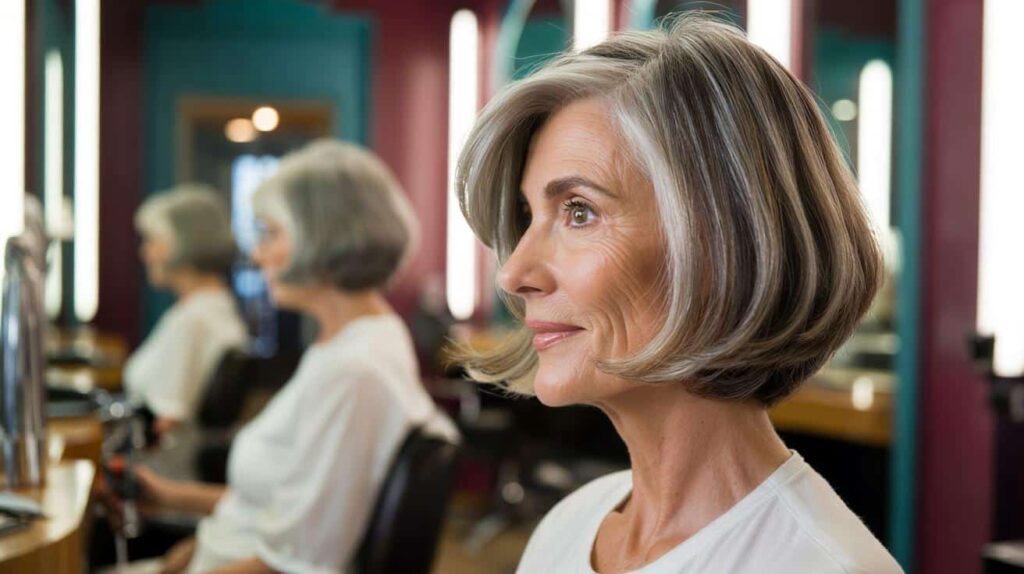
The hairdresser turned her head to the side, looked at the woman in the mirror, and said softly, “You know, you don’t have to wear this cut just because you’re 64.”
The woman laughed, but then she stopped. She had long hair that she wore in a low, tired ponytail, the same one she had worn since she was in her forties. It was useful, familiar, and “age-appropriate,” as her daughter liked to say. But the hairstyle that framed her eyes made them look older than they were.
In the salon, there were other women over 60 with short, stiff helmets of hair that had been sprayed into place. They all left looking neat but strangely older, as if their hair had been frozen in time.

The hairdresser picked up a strand, measured the jawline, and said quietly, “With the right bob, you’d look ten years younger.”
The woman’s reflection suddenly looked interested. Something moved in the room.
The cut that quietly takes the place of “old-lady hair” after 60
Professional hairstylists in the US and Europe keep telling people over 60 the same thing: “A modern bob is your best friend.” Not the stiff, round bob that was popular in the 1980s. A lighter, softer, and more textured version that moves with you when you walk and doesn’t sit like a helmet.
It’s almost like maths. After age 60, faces lose volume, especially in the cheeks and jaw. The right bob gives you that volume back with hair instead of makeup or surgery. It frames the face, shows off the neck without showing every line, and gives that ‘fresh’ look that people can’t quite put their finger on but always notice.
Hair experts all agree that hair that stops between the cheekbones and collarbones is the best length for a youthful look. Too long pulls the face down. It can get hard if it’s too short.
If you ask any experienced stylist, they’ll tell you the same thing. A woman in her sixties comes in and says, “I want something modern, but not too short.” She comes in a lot with long, thinning hair that she puts up because it “does nothing” when it’s down. Or with a very short, ultra-layered cut that she’s had for 20 years because “everyone over 60 cuts it short.”
The next scene is the one where the change happens. Mireille is 67 years old and a retired nurse. She agreed to a length just below the jaw, with a few layers in front and a line that went a little longer toward the chin. No crazy colour or style, just a clean, airy bob.
What happened? All of a sudden, her eyes popped, her cheekbones showed up in the salon lights, and her posture changed. She held her shoulders differently when she stood up from the chair, as if the new shape of her face gave her permission to stand taller. Later, her husband told the stylist, “She looks like she did when we met.”
There is a simple visual reason why this haircut makes you look younger. The modern bob makes a soft horizontal line around the face, which makes sagging areas look higher. It also makes things stand out more, like sharper hair lines against softer skin. That tension makes the face look more alive.
A bob adds structure and density to fine or thinning hair. The ends are healthier, the shape is clearer, and the overall look feels like it was planned, not like it was given up on. A layered bob keeps the curls’ energy while cutting down on the length that can make everything heavy.
Stylists also talk about the mental side of things. Women over 60 often have old hair rules in their heads, like “not too bold,” “not too long,” and “I’m too old for that.” These rules break down right at the point where a modern bob sits. It’s classic enough to make you feel safe, but also modern enough to say, “I’m still here and I’m not decorating a museum piece.”
How to ask for a young bob after 60 without crying
The trick isn’t to say, “Please give me a bob,” but to explain what you want your face to say. First, sit in the chair and talk about your life. Do you dry your hair with a blow dryer? Do you go on trips a lot? Do your hands hurt when you use a brush? The right bob should be true to your life.
Then, tell the stylist to cut your hair based on your jawline and not your birth certificate. A bob that looks young after 60 usually falls between the middle of the neck and just below the chin. The front is usually a little longer and the back is usually softer.
Don’t bring ten pictures; bring one or two. Say clearly, “I want it to be light and moving, not stiff.” Don’t ask for strands that are as thin as a razor. And say the sentence that sets many women free out loud: “I’d rather look modern than ‘nice for my age.'”
After 60, the worst thing you can do is get a bob that is technically a bob but looks very old-fashioned. This happens when the cut is too round, too sprayed, or too perfect. The hair hardly moves, the volume is on top of the head, and the face looks smaller and more tired. We’ve all been there: you leave the salon looking great but feeling like your aunt.
Going too short because you’re scared is another common mistake. Some women tell the stylist to “take it all off so I don’t have to deal with it.” Let’s be honest: no one really does this every day. The result can be a cut that is easy to work with, but not forgiving, with no softness around the features.
It’s better to leave a little bit of length. You can tuck a lock behind your ear, push your hair back with glasses, or change your part when you want to play with your look.
Sophia, a stylist in London, says, “I don’t cut hair to make women look younger after 60.” “I cut to show how much energy they still have. A modern bob is just the right shape for that. “The hair lifts, the eyes light up, and all of a sudden, the age on the ID doesn’t match what you see in the mirror.”
Lines that are soft and move
- Instead of one heavy, straight block of hair, ask for light layers and texture.
The distance from the chin to the collarbone
- Most older faces and necklines look good in this range.
Light on the face
- A little bit of light on the front or subtle highlights can make the eyes and skin tone look brighter.
Styling with little effort
- A cut that dries well in the air or only needs a quick brush and a little product.
No “helmet effect”
- Don’t spray too much or set curls so tightly that they don’t move when you do.
A cut that stays with you, not your age
Not only do hairstylists love how a bob changes a person’s face, but they also love how it changes the way people talk. Women come in talking about their age and leave talking about their plans. The haircut doesn’t get rid of wrinkles. It just stops pointing at them.
A bob that is well-cut can grow with a life that is still moving after 60. In the summer, it’s a little shorter, and in the winter, it’s a little longer and softer. Some women add a fringe a year later. While keeping the same sharp, modern line, some people get progressively greyer. The cut becomes a frame for all of these changes instead of a wall.

This is where the real youth effect happens. It’s not about trying to get the hair you had when you were 25; it’s about wearing hair that fits who you are now, whether you’re 62, 68, or 73. Not giving up, not hiding. Just clear, open, and a little risky. The kind of cut that says, “Yes, I’ve lived.” And I’m clearly not done.
Main pointDetail: What the reader gets out of it
| The shape of a modern bob | Length from chin to collarbone, light layers, and no “helmet” volumeInstant face framing and a fresher look without a big change |
|---|---|
| Changed to fit lifestyle | Cut based on how you style your hair, how easy it is to move around, and the texture of your hair.Every day, hair that looks young, not just on the day you go to the salon |
| Soft colour and movement, subtle highlights around the face, natural texture, and not too much hairspray. | A brighter complexion, a more dynamic look, and less of a “old lady” effect. |