For a second, everyone was quiet when the hairdresser turned the chair around.
Marie, 73, with silver frames on her nose, was looking at a woman in the mirror who she sort of knew. The short, layered cut that skimmed her glasses made her cheekbones stand out all of a sudden, even though her eyes and laugh lines were the same. Her granddaughter said “wow” in a way that was more than a polite compliment.
We’ve all been there, that moment when the hair around our face either makes us feel good or bad.
After age 70, little things start to matter more. For example, the curve of a fringe, where the hair ends near the jaw, and how it moves around the temples of our glasses. A single good cut can sometimes take ten years off a person’s face.

The key is knowing which ones.

The soft layered bob that “lifts” the frame
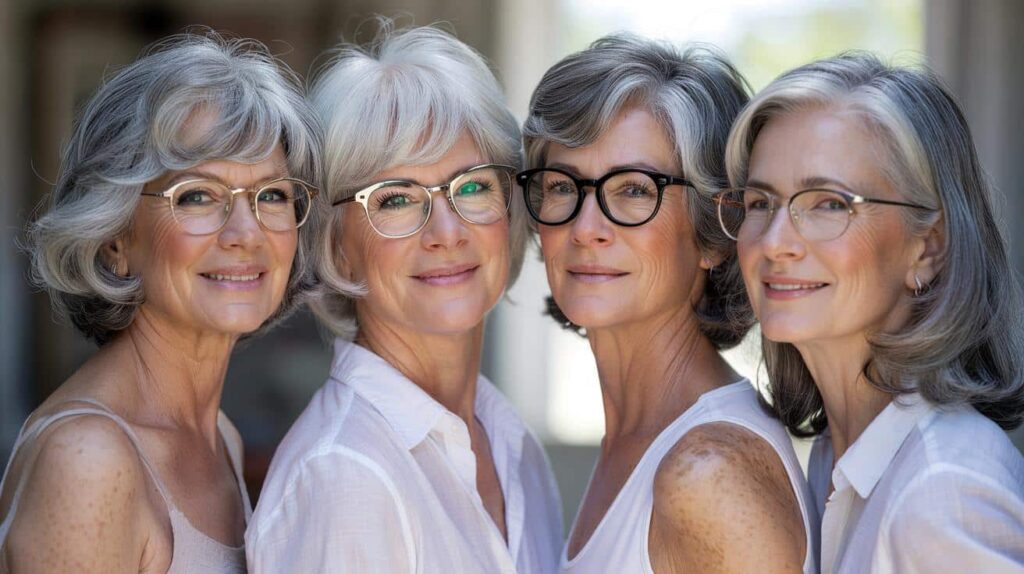
A soft layered bob that falls between the jaw and the base of the neck is one of the most flattering cuts for people over 70, especially if they wear glasses.
Not too stiff or shiny, just a little bit feathered at the ends so it doesn’t look like a helmet. Where the hair and glasses meet is where the magic happens.
When the length lightly touches the bottom of the frame, it makes a subtle lift effect.
The glasses stop looking like a wall and start to look more like jewellery that goes with the hair. A light side part and some movement around the temples make the whole upper face look more awake.
I saw this cut change a woman named Denise, who is 79 years old, in a small salon in my neighbourhood. She had long, heavy hair pulled back in a low bun and thick brown frames that made her look like she was carrying a lot of weight.
“Grandma, you look tired all the time,” her grandson had said, and that hurt.
The hairdresser suggested a chin-length layered bob with a little volume at the crown and soft pieces that brushed the tops of her glasses.
Something changed when Denise put her glasses back on with the new cut. Her jawline looked sharper, her neck looked longer, and her eyes looked brighter. She didn’t look “done,” she looked like she had gotten some sleep. And glad.
This cut works so well with glasses after 70 for a simple reason.
The bob keeps the volume around the cheeks and just above the ears, which makes the frames look more balanced. That balance makes the eyes and cheekbones stand out by drawing the eye up and away from sagging or hollow areas.
Because the viewer’s attention is higher, fine lines around the mouth don’t matter as much anymore.
Light layers add air and movement to thin hair, which keeps the style from falling around the face. The result is a softer outline, fewer sharp edges, and a face that looks younger and more alive.
The light fringe that covers up wrinkles without covering up the eyes
For a lot of women over 70 who wear glasses, the big question is whether or not to wear a fringe. The most refreshing choice is usually a light, airy fringe that hits just above or brushes the top of the frames.
Not a heavy, straight curtain. A light veil that you can pull apart with your fingers.
This type of fringe softens a high or prominent forehead and gently blurs deeper expression lines without covering the eyes.
It breaks up the “two straight lines” effect that can look harsh when it overlaps a little with the top edge of the glasses. The face feels less square and more relaxed and gentle right away.
Lucia, a 72-year-old retired teacher, told me that for years she had pushed her hair off her forehead because she was afraid a fringe would get in the way of her glasses.
She wore classic rectangular frames and had stopped noticing how much her deep forehead lines bothered her. Everything changed the day her granddaughter talked her into getting a wispy, side-swept fringe.
The hairdresser cut it so that the longest strands brushed the brows and slightly covered the frame. The shortest strands opened a clear window around the pupils.
Someone at the bakery the next morning asked Lucia if she had changed her glasses. “No,” she thought, “I just changed how my face meets them.”
It’s easy to see why: our brains see vertical and diagonal lines as more playful and youthful than harsh horizontal lines. A soft, broken-up fringe at the top of your glasses adds those vertical and diagonal lines, which draws attention away from every little line on your forehead.
The glasses give structure, and the fringe makes it softer.
There is one problem. If your fringe are too blunt or too heavy, they can block your eyes and make the circles under your eyes look bigger.
A light, slightly uneven fringe cut while wearing glasses keeps the eyes open and bright. *Think of it as a filter that makes your hair look softer.
The neck-skimming crop that opens up the nape and sharpens the jaw
The neck-skimming crop is another great haircut for people over 70 who wear glasses. It is short at the nape, longer on top, and has soft layers around the ears.
Not a strict pixie or a classic bob, but something in between that shows off the neck and gives the jaw some shape.
This cut looks best when there is some lift at the crown and a little volume above the frame line.
The short nape shows off one of the most beautiful parts of the body at any age: the back of the neck. Glasses then become a natural anchor point. The overall effect is light, lively, and almost sporty.
It’s true that having short hair can be scary. A lot of women tell me they’re afraid that if they cut it, they will look “too severe” or “too masculine.”
But when they finally do, the response is usually the opposite.
I remember Yolande, who was 81 years old and had very fine white hair and round metal glasses. Her long bob stuck to her cheeks and made her look flat. A young stylist suggested a crop that just touches the neck and has textured pieces above the ears. Yolande thought for a moment and then said, “Well, I won’t be younger tomorrow.”

The result was a crisp nape, side pieces that followed the arm of her glasses, and soft fullness at the top. She left the salon feeling lighter, both physically and mentally. People she didn’t know started calling her “pep.”
The way this cut changes the shape of the head and neck makes it look younger.
The posture looks straighter, the neck looks longer, and the shoulders look less hunched when the nape is clear. That clear line at the back stands out against the frame at the front when you wear glasses, making a modern, graphic balance.
Short hair also lifts away from thinning spots at the temples instead of sticking to them and showing them off.
Let’s be honest: no one really spends half an hour every day styling their hair. A neck-skimming crop that fits well will fall into place with a few fingers through it. This means that on a normal Tuesday, you are more likely to look polished than resigned.
The long layers that are softly rounded are for people who don’t want to go short.
It’s perfectly fine for some women to not feel like themselves without a little length.
After age 70, especially if you wear glasses, it’s important to change “long and straight” to “long and softly rounded.” That means soft layers that start around the cheekbones and end with a slight curve inward instead of hanging down.
Request face-framing pieces that fit along the top and bottom edges of your frames.
These strands make the lower face look slimmer and blur the sagging around the jaw when they fall softly along the cheeks. The hair and glasses then work together to draw attention to the eyes, like a frame within a frame.
I met a 76-year-old woman named Colette in a waiting room. Her hair was falling to her shoulders in a single, tired sheet.
Her glasses were pretty—thin, dark, and almost like art—but they didn’t seem to go with the rest of her look. She said she wouldn’t cut her hair because her husband, who had died, liked it long.
A few months later, I saw her again, and things were different. Her hair was still below her shoulders, but it was layered and had soft waves that started at the level of her glasses. The ends curled up toward her collarbones.
She looked taller, and her cheeks were slightly raised, as if someone had gently pulled everything up. She didn’t “change style”; she just changed the way her hair and frames talked to each other.
Long, rounded layers are a good way to get length while also fixing three common signs of ageing: heaviness at the bottom, flatness at the crown, and drooping in the jaw area.
The layers near the temples are similar to the upper angles of the glasses, which draws attention there. The curved ends act like brackets around the face, holding it in place and softening it.
The hair should be a little lighter at the ends and never completely straight so that this cut doesn’t pull the features down.
A little movement, a soft wave, or a quick blow-dry with a round brush is all it takes to keep the hair and frames from covering up the whole face.
How to pick “your” cut: your face, your frames, and how you really live
It’s not just about age or trends when it comes to the best hairstyle after 70; it’s about your real life.
A good place to start is to put on your glasses, sit in front of a mirror, and use your eyes to draw the shape that your hair makes around your face right now. Is it a square? A triangle? An oval that droops?
Then think about which of these four cuts would best change that outline into something softer, more open, and more lifted.
A simple rule: the hair shouldn’t stop right where the face starts to droop. Never go right to the “weak point.” Always go a little higher or lower. That small change can make a face look years younger.
There is one more thing we don’t often talk about: your willingness to style.
If you hate blow-drying, a haircut that needs to be brushed every day will make you angry all the time. Very fine hair is usually easier to deal with when it’s cut short or in soft bobs than when it’s long and layered.
Don’t be afraid to tell your hairdresser how you really take care of your hair on weekday mornings, not just on holidays and weddings.
A cut that works with your lifestyle will make you look younger, even if it’s not “perfect” on paper. An ideal cut that you never actually keep up with will make you look older. Hair and glasses are worn every day, not on Pinterest.
“After 70, a good haircut is not about hiding your age,” a veteran stylist in Paris told me.
“It’s about letting your face breathe again, especially around the eyes. Glasses don’t age you. The wrong outline around them does.”
- Soft layered bob: brightens the upper face and lightens the jaw area.
- Airy fringe: softens forehead lines while keeping the gaze open above the frames.
- Neck-skimming crop: frees the nape, sharpens the jaw, adds energy around the glasses.
- Rounded long layers: preserves length, slims the lower face, and harmonizes with the frames.
The quiet power of hair that agrees with your glasses
At some point, past 70, the fight against time becomes exhausting. Hair can either join that fight or drop the weapons and offer something gentler: harmony.
When the cut respects the lines of your glasses, highlights your eyes, and skims – instead of clinging to – the areas that weigh you down, you don’t look “younger at all costs.” You look more like yourself.
These four cuts are only starting points. The real magic happens when you sit in the salon chair, glasses on, and talk honestly about what you like, what you fear, and how you want to feel leaving that chair.
Maybe the next big change won’t be about daring color or chopping everything off.
 How to keep mice seeking shelter out of your home : the smell they hate that makes them run away
Maybe it will simply be about letting your hair and your glasses stop arguing and finally start working as a team around your face.

| Key point | Detail | Value for the reader |
|---|---|---|
| Choose cuts that interact with the frame | Lengths aligned with top or bottom of the glasses visually lift the face | Makes features look fresher without drastic changes |
| Prefer softness and movement | Light layers, airy fringes, rounded ends instead of blunt, heavy lines | Softens wrinkles and sagging, keeps the overall look gentle |
| Match hair to real habits | Adapt style to how often you truly style or dry your hair | A cut that lives well every day looks younger than a “perfect” but impractical one |