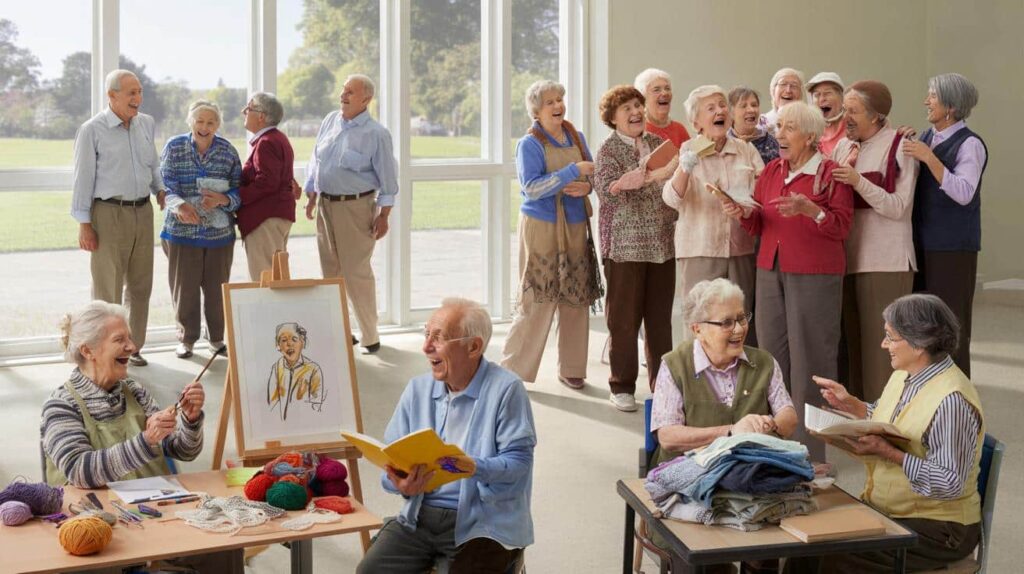
There was a faint smell of coffee and floor polish in the community hall. A retired bus driver was learning his first guitar chord from a YouTube video at the back, under a buzzing neon strip. His fingers were stiff but he was determined. Two widowed women were arguing quietly over a chessboard near the window. They were laughing louder than their moves called for. No one in this place wanted to be “young” again. They were just trying to stay together.
We don’t talk about those long, quiet afternoons that start to stretch out after work, kids, and deadlines are gone.
Psychologists call what fills that space “hobbies.” But they’re not just ways to pass the time. They are lifelines.

1. Walking in a group: moving bodies and making new friends
Walking with other people is probably the most underrated hobby for people over 60 to start. Not fitness walking with a stopwatch, but those slow, chatty loops around the park where people talk about their knees, grandkids, and the price of tomatoes. Walking next to someone makes it easier to talk. You don’t have to look each other in the eye; the conversation just flows.

Psychologists call this “side-by-side interaction,” and it’s great for people who are shy or have just become single. The path, the weather, and the dog that looks like its owner are all things that people are interested in. When there’s a meeting time, a familiar path, and someone who will notice if you don’t show up, loneliness gets smaller.
For example, Marta, who is 72 years old and moved to a new town after her husband died. She was too scared to join a choir or a book club because they seemed too intense. A neighbour “just once” dragged her to a walking group on Wednesday. She didn’t say much on the first day. Someone asked about her accent the second week. A month later, she was the one who told the other people in the WhatsApp group to bring water.
A study in the UK found that older people who walked in groups were less likely to be depressed and had better overall health. It’s not the steps on the smartwatch that make the difference; it’s the little things you do together, like making fun of the weather, complaining about politics, and waiting at the same stubborn traffic light. These little, predictable moments begin to feel like home.
Big, dramatic changes don’t always make loneliness go away. It often slowly breaks down through small connections. Walking in a group is the perfect balance: it’s not too much work, it’s easy to plan, and the pace works for most people. Having a set day and a group that expects you to be there helps you plan your week.
This is a big deal from a psychological point of view. Having a routine gives you a sense of control. Endorphins are released when you move. Being outside gives you the chance to meet new people and get some sunlight, which helps your mood. When you put it all together, a simple walk once or twice a week becomes a way to improve your mental health while also getting some fresh air.
2. Arts and crafts in the community: using your hands to heal your mind
In a room where people are making things, there is a certain kind of silence. The sound of paper rustling, scissors snapping, and wool sliding over fingers. Crochet, pottery, watercolour painting, and woodworking are all things that keep your hands busy and your mind from thinking about old worries. This kind of “flow” is a strong way for older people to stop thinking about things over and over again.
It’s easy to get started. You can do it at a community center, a craft corner in a charity shop, a library workshop, or even a church basement. It’s not about talent. The point is to sit at a table with other people and be able to talk about something other than your medical file.
A man in his 80s who was taking an art class told me that he hadn’t drawn since he was 10. He shrugged and said, “Life got too serious,” still looking at his sketch. By the fourth session, he was showing up early to save seats for two women he had met there. After that, they went out for coffee and laughed about how badly they had tried to get a new perspective.
Studies on “art-based interventions” for older people show that they lower anxiety and make people more social. But let’s be real: when you show someone your crooked scarf or lopsided bowl, you’re giving them a soft, safe part of yourself. And they usually respond with kindness instead of grades. That kindness is a direct hit to the feeling of being invisible.
It’s just as interesting to see what’s going on in the brain. Craft activities help you focus and coordinate, which brings your mind back to the present. Knitting or carving the same thing over and over can calm the nervous system, just like meditation. When this happens in a group, there is another layer: people making the same mistakes, encouraging each other, and joking about who is the “worst” in the room.
According to social psychologists, people bond more quickly when they do something imperfectly together than when they sit in a circle and talk about their feelings. *It’s easier to show someone your shaky painting than your biggest fear of being alone when you die.* These little talks turn into real relationships over weeks or months, much more than a simple “How are you doing?”
3. Singing with other people: the science of choirs and amateur music
People are often afraid to join a choir. They say things like, “I can’t sing,” or “I’m too old to start.” But there are a lot of people in choirs who said that and still came. There are too many voices and names at the first rehearsal, which makes it feel like chaos. Then, little by little, you find out where to stand, when to breathe, and who always makes a joke during warm-up.
Choirs are a great way to improve your mental health. You get to see people on a regular basis, have a clear role, learn new things, and have those “goosebumps” moments when everyone hits the same note. Breathing, posture, and vibrations in the chest all work together. That physical closeness makes you feel emotionally close, even if you never tell each other personal stories.
Research from Finland and the UK has shown that older people who sing in choirs feel less lonely and have more “meaning in life” than those who don’t sing. A 68-year-old former accountant said that choir night was “my anchor; if I didn’t have it, the week would fall apart into one long blur.”
I went to a choir practice in a small town once, and most of the people there were over 65. No one talked about music theory during the break. They talked about their hospital stays, compared recipes, and made fun of the conductor’s socks. Three other sopranos took turns visiting her at home when one of them stopped coming. The choir was the reason the network got started. The notes didn’t tell the whole story.
From a psychological point of view, music affects memory, identity, and emotion all at the same time. People can reconnect with different parts of themselves by singing songs they know. For example, the teenager at a school concert or the young parent humming lullabies. That inner continuity is important as we get older, when roles start to fade and the question “Who am I now?” starts to get louder.
And then there’s the part where you act. Getting ready for a small concert, even one with just 20 people, gives everyone a common goal. Social scientists are aware that shared objectives strengthen connections more effectively than informal conversation. The crowd isn’t just clapping for the music at the end. It’s a public acknowledgement: “You came, you tried, and you still do something bigger than yourself.”

4. Volunteering: going from “being helped” to “being needed again”
If you ask any psychologist who works with older adults, they’ll tell you that feeling useful is one of the best ways to avoid loneliness. Volunteering changes a painful story. You stop being the one who needs help all the time and start being the one who gives it. That change in identity can be life-changing after you retire, lose a spouse, or get sick.
There are a lot of options. Reading stories at the library, helping a teen, working at a food bank, or answering phones for a local charity. One morning a week is enough to change the story in your head from “No one needs me anymore” to “If I don’t go, someone will notice.” That feeling of being expected is quiet but strong.
There is evidence for this. Several long-term studies have found that older people who volunteer regularly are less likely to be depressed and have better cognitive function. But there is always a simple scene behind every graph. An ex-nurse teaching people at a shelter how to stay healthy. A mechanic who used to work on bikes fixing bikes that were given to them. A grandmother helps new immigrants learn the language.
A 74-year-old volunteer at a thrift store told me, half-jokingly, “They can’t fire me; I’m the only one who knows where the winter coats are.” That line had a deeper meaning: she had a place, a role, and a part of the city where she was important. When your name is on a rota, loneliness has less room to grow.
Researchers say that volunteering helps people develop “prosocial behaviour” in their minds. When you give time and energy, it activates reward circuits in the brain, not just in the person who gets it, but also in the person who gives it. Even if they were tired when they got there, people say they feel “lighter” and more energised after helping.
There is another level: when you volunteer, you meet people from different cultures, younger generations, and life stories. That variety can make you feel less “stuck” in an age bubble where everyone talks about the same pains and pills. Opening doors and mixing circles a little bit keeps curiosity alive. And being curious, no matter how old you are, is a quiet way to fight despair.
5. Learning circles: book clubs, language classes, and the fun of not knowing yet
When someone who is 70 years old realises they can still learn something new, their eyes light up in a special way. Language classes, book clubs, philosophy cafés, and even online courses with small groups are all hobbies that are more than just ways to pass the time. They make you think and help you build your social identity around something other than being “retired” or “widowed.”
Joining a book club or discussion group is a lot easier than joining a sports team or choir. You can sit down and listen at first, then slowly test your voice. Social psychologists say that talking about outside things like books, films, and ideas is a safer way to get to know someone better than starting with “Tell us about your life.”
A study in Italy found that older people who learned a new language by going to class once a week not only did better on memory tests, but also made more friends. People began creating WhatsApp groups to exchange jokes in the new language, coordinate minor travel itineraries, and share recipes pertinent to the culture they were examining.
In a classroom in the suburbs, I met a group of retired women who were learning Spanish. No one wanted to move to Spain. They just wanted something to look forward to every Tuesday. They started coming early, bringing pastries, and staying after class “just for ten minutes,” which always turned into an hour. The grammar was just an excuse. The real lesson was: my week has a plan, my thoughts are important, and my brain is still working.
From a psychological standpoint, learning circles combat loneliness on three levels. First, cognitive stimulation keeps your mind clear, which can make socialising feel tiring. Second, there is a built-in flow: one book leads to the next, and one class builds on another, making a story that never ends. Third, sharing your thoughts or questions softly shows who you are.
Let’s be honest: no one does this every day. Life, being tired, and having to go to appointments get in the way. But having even one regular learning space during the week works like a gym for your mind and a place to meet people. Just getting ready for class by thinking about a chapter or practicing a few sentences pulls you forward in a way that loneliness doesn’t last long.
Small steps can help you stay safe from loneliness.
What comes out of all this is not one magical hobby, but a pattern. Psychologists say that the activities that best keep older people from feeling lonely are the same: they are regular, done with other people, a little hard, and a little fun. Walking, doing arts and crafts, singing in a choir, volunteering, and learning circles are all examples of things you can do. Ten names, one need that runs through them all.
We weren’t made to spend the last decades of our lives looking at the world through a window or a screen. We need to feel like we belong, even if that means being in a room full of people singing off-key or sitting on a park bench after a long walk.
If you’re reading this and already feeling the weight of some empty hours, the answer is usually not to “be more positive.” Most of the time, you go somewhere, even if it’s awkward, where other people are doing something you kind of like. Just one small promise. A date on the calendar that isn’t a doctor’s appointment.
Psychology can measure loneliness in numbers and scales, but in real life, it looks like this: someone knows your name. When you’re not there, someone notices. Someone is waiting for you on Wednesday at 10 for the walk, the class, and the rehearsal. The bridge is the hobby. The crossing is the real goal.
The question is not so much “Which hobby should I choose?” as it is “Where can I regularly stand or sit next to others with a common goal?” Some people will knit in a busy café. For some, it’s joining a local theatre, a bird-watching group, a cycling group, or a gardening club.

The good news is that there is no age at which starting is silly. From a psychological point of view, the only choice that is really risky is to wait for connection to knock on your door without being invited. A small, slightly uncomfortable step often comes between “I’m so alone” and “See you next week at the same time?”

| Important point | Value for the reader in detail |
|---|---|
| Regular activities with others are better than doing things alone. | Walking groups, choirs, and book clubs are examples of hobbies that keep you in touch with other people and give you a routine. |
| Feeling useful is good for your mental health. | Volunteering or being a mentor can help you feel needed and valued again. |
| Language classes, crafts, or music are all great ways to keep your identity alive. They stimulate your brain and help you meet new people. | Helps readers see that they are getting better with age, not worse. |