Then a small thing in his brain changed everything completely.
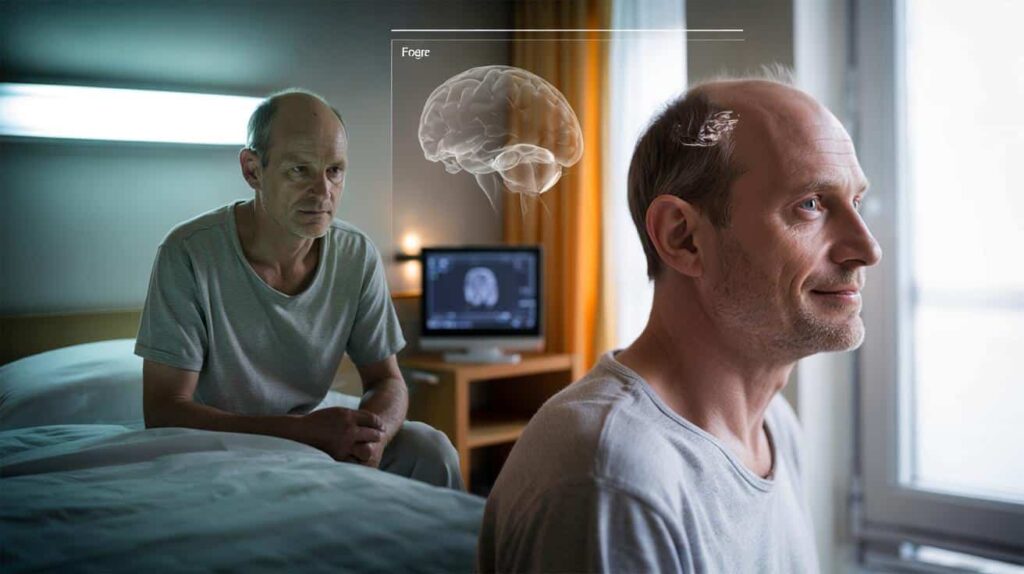
A 44-year-old French patient who had been depressed almost all of his life saw a change in his mental state after an experimental brain procedure. This gave new life to the promise of high-precision psychiatry.
A life shaped by constant sadness
The man’s story starts early. The clinical report says that his first symptoms showed up when he was a child. Over time, they got worse and worse until they became a chronic and suffocating state of despair.

He lived through what psychiatrists call a long-lasting depressive episode for 31 years, with no clear breaks. There was no stretch of months or even weeks that really helped him. His life became a constant state of suffering.

Doctors tried almost everything that is available in modern psychiatry. Over the course of twenty years, he had about twenty different treatments:
- several kinds of antidepressant drugs
- mood stabilisers and antipsychotics used together
- a number of structured psychotherapies
- non-invasive methods of brain stimulation
- hospitalisations during suicidal crises
None of these plans worked for a long time. Every time we tried, we felt a little hopeful but it didn’t work out.
The patient exhibited characteristics indicative of severe, treatment-resistant major depressive disorder for over thirty years, a condition that affects approximately one-third of individuals with chronic depression.
His symptoms were the typical, severe ones: feeling emotionally numb, having constant negative thoughts, withdrawing from social situations, and having trouble thinking clearly, which made even simple decisions feel impossible. Thoughts of suicide came and went, sometimes very strongly.
At this point, the tools of regular psychiatry were almost all used up. The care team had to answer a familiar but tough question: what do you do when nothing seems to work anymore?
A new frontier: brain stimulation that is very personalised
Instead of going back to another drug combination, a research group suggested a new way of doing things: implanted brain stimulation that is very specifically designed for this one man’s neural circuits.
PACE, the name of the experimental protocol, doesn’t use a simple on-off electrical pulse. It uses detailed brain mapping to find the exact networks that seem to be keeping his depression going.
Three important areas were picked as targets:
The dorsolateral prefrontal cortex is important for planning, making decisions, and controlling your thoughts. The dorsal anterior cingulate cortex is important for keeping track of your feelings, pain, and conflicts. The inferior frontal gyrus is a center for language, controlling your emotions, and controlling your impulses.
Surgeons put electrodes in these places with a millimetre of accuracy. The device then sent out small pulses of current, but the important thing was that the intensity and pattern of the stimulation were not set.
The system worked in a feedback loop, changing the stimulation in real time based on what the patient’s brain activity showed, instead of sending a constant, blind signal.
This adaptive part is very different from many older types of deep brain stimulation (DBS), which often use continuous or pre-programmed impulses. In this case, sensors keep track of neurophysiological signals and send them to an algorithm that adjusts the stimulation in real time.
The approach is still in the preprint stage, as it is described in a scientific paper that was uploaded in 2025 and has not yet been peer-reviewed. However, it already stands out for how personalised it is.
Putting theory into practice in the operating room
Before the surgery, the team spent weeks gathering brain imaging data while the patient did tasks that tested their emotions and thinking. These scans helped make a map of his own depression network.
Neurosurgeons put thin electrodes through small holes in the skull during the procedure, following paths that were planned based on MRI images. A stimulator that was about the same size as a heart pacemaker was put under the skin and connected to the electrodes.
After being turned on, the system started to record brain activity and send him patterns of stimulation that matched his internal changes. In the first few days and weeks, settings were changed with the help of engineers, psychiatrists, and the patient himself.
The first signs that your emotions are coming back
The research team says that changes didn’t happen overnight, but the first small ones did happen fairly quickly.
The patient allegedly experienced “a slight lifting of the fog” within days. He noticed times when he was curious about things he hadn’t been curious about in years, like what to cook or what movie to watch, instead of just not caring.
The team used a number of tools at the same time to keep track of these changes:
| What it captured | in the measure |
|---|---|
| Diary every day | Mood, energy, and motivation as described by the person |
| Standardised questions | How bad depressive symptoms get over time |
| Tests of thinking | The ability to pay attention, remember things, and make decisions |
Changes weren’t always smooth; some days were better than others. But over the course of several weeks, the overall trend was up.

The man’s suicidal thoughts were said to have gone away after seven weeks of stimulation. His mood scores had gone up by about 59% on established clinical scales after four months, and the improvement lasted for at least 30 months.
That long-term stability is impressive, especially since decades of traditional care had only been able to keep gains for short periods of time.
Researchers talked about a slow “emotional awakening.” Things that used to seem pointless slowly became fun: hanging out with a friend, going for a walk, or listening to music. These experiences didn’t make him carefree right away, but they did show that he was moving from just surviving to being able to enjoy things.
Not a miracle cure, but a proof of concept
Even though this case is very interesting, the people who worked on it are careful about the message. One patient, even if followed for more than two years, does not ensure that the method will benefit others similarly.
The study has not yet been reviewed by other experts, which is an important step where they look at the data and methods. Safety is also closely watched because all brain surgery has serious risks, like bleeding, infection, or a broken device.
Researchers regard this case not as a completed treatment but as a proof of concept for a future where psychiatric care can be customised to an individual’s distinct brain networks.
They emphasise that invasive interventions ought to be limited to the most severe and refractory types of depression, following the failure of conventional treatments such as pharmacotherapy, psychotherapy, and non-invasive brain stimulation.
How this is different from other attempts at deep brain stimulation
Deep brain stimulation isn’t new; it’s been used for years to treat Parkinson’s disease and other movement disorders. Several teams have also tried it for depression, but the results have been mixed.
This new method makes two big changes:
- network focus: targeting circuits that connect emotions and thoughts, not just one part of the brain;
- adaptive control: letting the device respond to changes in brain states instead of following a set stimulation program.
In theory, this could lower side effects and make the treatment more effective because the stimulation isn’t always applied at the same level when the brain is already pretty stable.
What this could mean for people who are very depressed
For a lot of families whose depression won’t go away with treatment, this kind of story brings up both hope and fear. It shows that the brain can still change after 30 years of pain, but only when the right switches are pushed. But this kind of technology won’t be available to everyone right away.
In the short term, the direct effect is only on a few clinical research centers that have the necessary skills and ethical approvals to do these procedures. Costs are likely to be high, and there will be strict rules about who can join.
Still, the bigger picture is very important. The case supports a growing movement in psychiatry that calls for “precision mental health,” which means customising treatments not just to symptoms, but also to each person’s brain patterns, genetics, and life history.
In the future, researchers might use this kind of stimulation along with digital tools like symptom-tracking apps, wearables that keep track of sleep and activity, or even virtual reality therapies that teach people how to control their emotions while their brain circuits are being changed.
The main ideas behind the technology
What does it mean to have treatment-resistant depression?
When a person has tried several evidence-based treatments at the right doses and for the right amount of time but hasn’t gotten better, doctors use this term. In practice, it usually means:
- two or more antidepressant trials with inadequate or transient response;
- diminished efficacy from structured psychotherapy;
- persistent impairment in daily functioning.
Individuals in this category encounter elevated risks of disability, physical illness, and suicide. People often think about new strategies, even complicated ones, because the other options are so bad.
Getting the idea behind the feedback loop
This case’s device is based on a simple engineering idea called feedback control. The system is always measuring something, like brain activity patterns, and then it changes its output based on what it sees.
The stimulator can gently increase its pulses if certain signs of deep despair go up. You can lower the stimulation when the signals look more stable. This keeps the brain from getting too much stimulation when it doesn’t need it and focuses the effort on times when it is weak.
Possible situations, risks, and questions for the future
Think about a network of specialised centers that will offer similar services in ten years. A person who has been depressed for decades and has tried every recommended treatment might have detailed brain scans and cognitive tests done on them. Their scans would be compared to a growing database of scans from other patients to help them find the best place to put the electrodes.
Eventually, their device at home could talk to a secure monitor and send doctors anonymous data. If patterns of relapse were noticed early on, stimulation could be changed before a full-blown crisis happens. This kind of thing could happen in real life, but it needs long-term safety and strong proof from many trials.
There needs to be clear communication about risks. There must be open discussions about surgical complications, hardware failures, unintentional changes in personality or emotional range, and ethical concerns regarding direct brain intervention. Consent is not a one-time thing; it is an ongoing conversation, especially when the treatment can change how someone thinks and acts.

The 44-year-old patient at the center of this case sends a quieter message: depression that has been around for a long time may not be as permanent as it seems. Some minds that have been in the dark for decades might still be able to find light with the right technology and close human support.