I like the Tuesday 9 a.m. The salon is still quiet, the coffee is fresh, and my regulars come in with that mix of trust and mild panic that you only see around hair. Claire, 56, is running her fingers through her fringe this morning with a sigh. She says, “It just sits there.” “No volume, no shape.” I think my hair got older faster than I did. I’ve heard that line so many times that I could sew it onto a pillow.
We talk about the shape of her face, her glasses, and how much time she is willing to spend with a brush. We agreed on the same cut ten minutes later that I suggest to almost all of my clients her age with fine hair. The one that changes everything without saying a word.
The short haircut I think is best for fine hair after 50
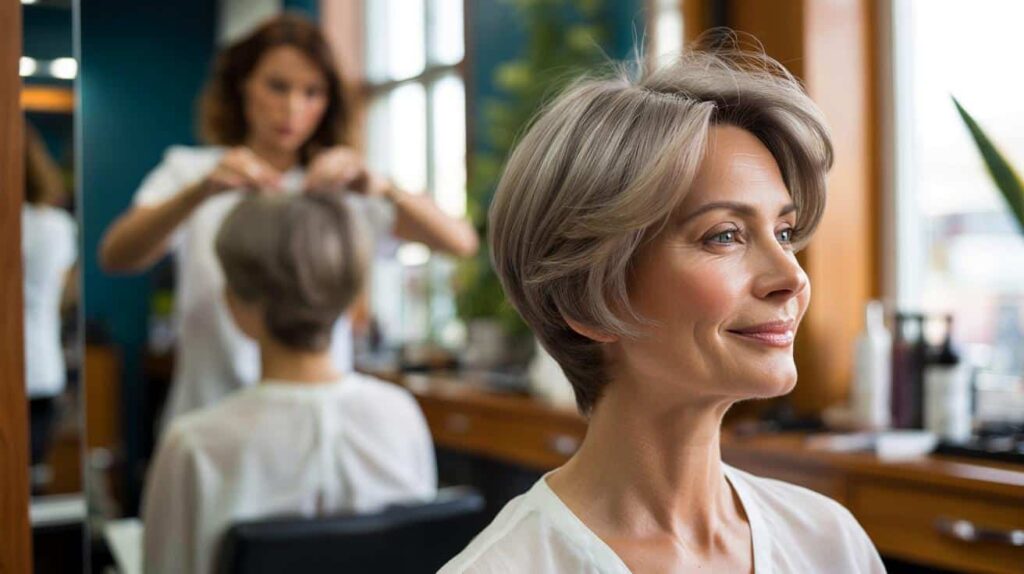
When a woman with fine hair comes to me for a haircut after 50, I usually tell her to get a modern, softly layered pixie-bob. Short in the back, a little longer around the face, and light and airy on top. Not a boyish crop. Not a stiff bob. Something that moves in between.
The goal is simple: make your hair look full without making you fight with it every morning. Shorter in the back makes it look higher. A little bit of extra length in front keeps the feminine look. That balance makes the whole face look different in the mirror.

Marie, who was 63, came in with hair that was very fine and shoulder-length. She said she “couldn’t do anything with it.” Her ponytail was as thin as a string. She was sure that going shorter would make it worse and that she would leave looking like her brother.
We gave her a layered pixie bob that skimmed just below the cheekbones, left a soft, side-swept fringe, and hugged the neck at the back. The crown almost lifted on its own when I dried it with a round brush. She kept touching the sides and saying, “It feels like I have more hair.” That’s the secret. You don’t grow volume; you design it.
Fine hair over 50 changes not only in thickness but also in how it behaves. The scalp can become more visible, and the strands often get silkier, which sounds nice but makes them slip flat. Length pulls them down. They look stringy because they have too many layers. Without any layers, the head looks like a flat curtain.
This is why that pixie-bob in between works so well. The shorter nape makes everything look higher. Instead of using mousse, soft, graduated layers through the crown add natural volume. You can style it in a few different ways if you leave a little length on top. You can push it back, part it, or make it look a little messy. The cut does most of the work, so your products don’t have to.
How to ask for this cut and deal with it
When you sit down, don’t just say, “Short, but not too short.” That’s how disasters happen. Request a graduated pixie-bob with soft layers through the crown and slightly longer pieces framing the face. Tell them that your hair is fine and you don’t want it to look choppy; you want it to look thicker.
Yes, bring pictures, but make sure the women you choose have the same hair density and age. An Instagram model with hair extensions won’t help your hairdresser. A good reference is often enough to point to and say, “I like this length at the front, but maybe a bit more volume on top.”

You won’t style your hair at home if it’s too hard. To be honest, no one really does this every day. Gently towel-dry your hair, then spray a light volumising spray only at the roots. Finally, blow-dry your hair while lifting it at the crown with your fingers or a small round brush.
Stay away from thick oils and creams; they’ll ruin all the work you just did. If you like products that are “airy,” try foams, root sprays, and dry shampoo. If your arms get tired or you don’t like heat tools, this cut still looks good when it dries on its own with some texturising spray scrunched through the top.
I tell my clients a lot, “You’re not trying to tame your hair; you’re trying to work with it.” Fine hair wants to be light, move, and take shortcuts. When you stop trying to make it look like thick, dramatic hair, styling goes from being a fight to being a habit.
- Instead of a harsh undercut, ask for a soft graduation at the back. This will help the shape grow out nicely.
- If you’re worried, leave some length around your ears. You can always get a shorter cut at your next appointment.
- Get a trim every 6 to 8 weeks so the layers don’t fall apart and the cut doesn’t turn into a fluffy triangle.
- Use a small amount of lightweight styling cream, about the size of a pea. If your fingers feel slippery, you’ve used too much.
- Check your hairline: a nape that is a little ‘bitten in’ often looks fresher than a straight, blunt line.
Why this cut feels like a small reset after 50
When you’re over 50, cutting your hair shorter, especially if it’s fine, is a quiet but radical thing to do. You don’t want to catch up to your 30-year-old self. You’re accepting that your hair has changed and making plans based on who you are now. That usually has effects on other parts of life that people don’t expect.
I can tell by the way women sit up straighter when they see their new reflection. When they say, “I actually look like me again, just… lighter,” it’s like they see themselves in the mirror every morning.
The layered pixie-bob works because it adds volume to the crown and temples, which is where fine hair tends to lose it. It works on an emotional level because it lets you know that you can change. You can let go of that long, thin ponytail that was secretly making you feel older. You can have a haircut that fits your real life, like work, grandkids, early mornings, late dinners, and busy hands.

Some clients text me weeks later to say that strangers have complimented their “great hair,” even though nothing has changed except the shape and a little bit of courage. That’s the quiet strength of the right short cut after 50. It’s not yelling for attention. It’s just you, a little sharper and brighter, ready to get on with your day without your hair getting in the way.

| Main point | Detail | What the reader gets out of it |
|---|---|---|
| Shape of a pixie bob | Short, graduated nape with longer, softer pieces in front | Keeps hair looking thicker while still being feminine |
| Styling that is light and airy | Root spray, a gentle blow-dry, and not a lot of product | Volume without complicated routines or a lot of buildup |
| Regular care | Trims every 6 to 8 weeks to keep the layers even. | The cut grows out nicely and keeps its “fresh from the salon” look. |