It always seems like the first white hair shows up on a Tuesday morning.You see it in the bathroom mirror: a thin silver line cutting through your usual colour. You reach for it right away. Pull, look, and sigh.You park in front of the hair dye aisle at the grocery store later, and your eyes jump from “Chocolate Chestnut” to “Midnight Black.” You mentally add up the mess, the smell, and the hours you lose every month.
Then you see something new in your feed: women and men your age with soft, blended tones instead of loud greys. No harsh roots, and no flat colour on the helmet.
Why classic hair dye is slowly going out of style
You can see it in any neighbourhood salon on a Saturday.

The queue of women with plastic caps and that well-known smell of ammonia is getting shorter. Stylists are spending less time lining up tubes of permanent dye and more time mixing small amounts of creams and pastes in small bowls.

Her roots were half grey, her ends were almost black, and she looked more tired than she was. “I don’t know who I am,” she said to the colourist, holding a box of dye she had brought “just in case.”
The stylist suggested a different way to do it: grey mixed with very thin highlights, a toner that was a little cooler, and a gloss that matched her natural base.Two hours later, the grey was still there, but it had spread out and changed into caramel and ash colours.
Her face suddenly looked less marked and her eyes were brighter.Marie saw her reflection on the tube ride home and thought, “I look like myself again, but I’m more rested.”
Most of the time, classic permanent dyes make things look flat and opaque.That can still look fresh on young hair. The contrast between hard colour and white regrowth on hair with a lot of grey makes the face look older faster than the grey itself.The new trend takes that reality into account instead of ignoring it.
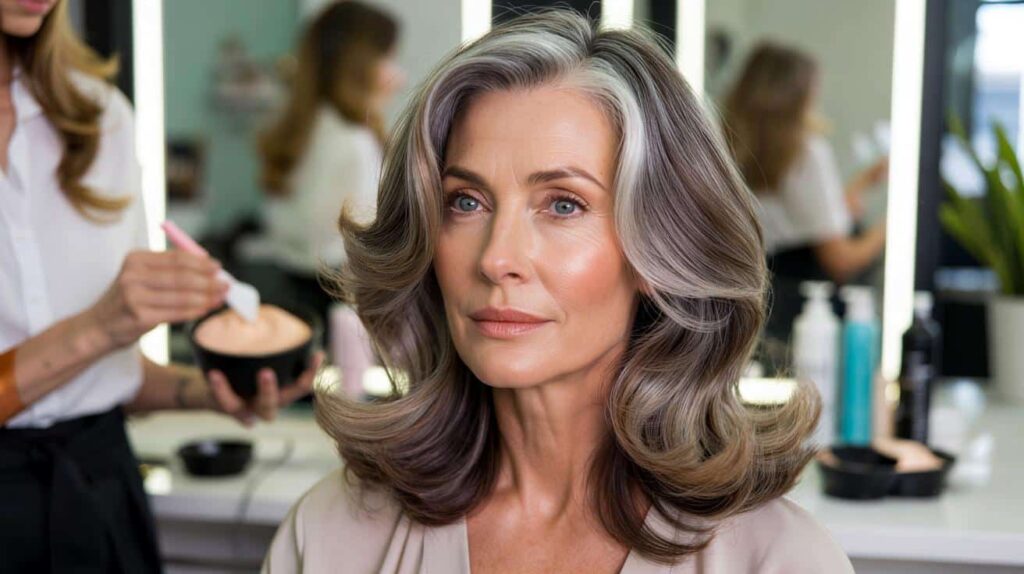
Colourists use semi-permanent dyes, toners, lowlights, lights, and even plant-based pigments to make the line between “coloured” and “white” less clear.We see it as texture, movement, and softness.You don’t see grey hair from far away; you see depth.That little visual trick can take years off a person’s face without anyone being able to point out a single obvious change.
The quiet revolution: blending grey, toning, and soft transitions
Colourists now call grey blending the backbone of this new movement.Instead of dyeing your hair all the way from root to tip, they weave in very fine highlights or lowlights that are only a shade or two different from your natural colour. The goal is not to get rid of solid grey patches, but to “break them up.”A soft toner is often added at the end. This is a see-through veil that makes your colour a little cooler or warmer.A cooler toner can change harsh yellow-greys into stylish, smoky strands on brown hair.A violet or champagne glaze on blond hair gets rid of the “fried” look and makes it soft again.
The hair moves and shines, and the grey hair is no longer a problem.Some people are giving up box dyes at home in favour of a simple routine that includes tinted conditioners, glosses, and root touch-up powders only where needed.Emma, who is 52, used to dye her hair every three weeks like clockwork. She says, “I panicked if I saw one white line along my parting.”
She now goes to the salon twice a year for a big, subtle blend session. To keep the look, she uses a cool-tinted purple conditioner once a week and a soft brown root spray only at the temples.Done in ten minutes.People at work keep telling her she looks “rested” and asking if she changed her skin care routine.She grins and doesn’t anything.
Let’s be honest: no one really does this every day.This new style makes sense in a simple way.The solid colour makes the line between “before” and “after” stand out. That clear line at the roots is what makes us look in the mirror and say, “I’ve aged overnight.”Blending grey makes that line less clear.
The contrast between white regrowth and coloured hair gets softer when you use translucent products and colours that are close to each other. The eye stops looking for the “line of shame.”That changes everything in your mind.You don’t chase your roots every two weeks. Your hair is changing, but not as quickly or dramatically as before. That calmer rhythm shows on your face.*You look younger now that you don’t fight with your reflection every morning.*

How to follow the trend without ruining your hair (or your nerves)
Buying something new isn’t the first step.It’s making an appointment to talk. A real one, with no filters, and a colourist who knows that grey hair is a texture, not a failure.Bring pictures of hair you like, not to copy the colour, but to get the feel: soft, shiny, and not too much.Instead of a full permanent dye, ask for techniques like “grey blending,” “soft balayage,” “smudged root,” or “glossing.”
Sometimes, all it takes to make the whole expression better is to darken some strands around the face and lighten some pieces inside.You leave with your greys still there, but no one sees them right away.The biggest mistake people make at home is over-correcting.The more we focus on the smallest white line, the more stuff we put on it, and the more damage and dullness we cause over time.Instead of making the rhythm tighter, try making it slower.Add one or two weeks to your appointments. Don’t wash your hair with toning shampoo every time; do it once a week so it doesn’t turn violet or khaki.
Don’t go three or four shades darker than your natural base “to cover better.” That makes a harsh border when the grey grows back and can even make you look older.When you look in the mirror, be nice to yourself. That little bit of softness changes how you go about your day.One colourist I talked to said it straight out:”People come in and ask me to get rid of their grey hair.” I tell them, “I can do something better: I can make people not notice them.”
Then she wrote a short list on the back of a business card and slid it across the table.
- Pick base colours that are close to your natural skin tone.
- Not just harsh permanent dyes, but also glosses and demi-permanent dyes.
- Instead of one flat colour, mix highlights and lowlights.
- Masks, oils, and leave-ins keep grey hair from looking wiry.
- Accept a little grey; the contrast is what bothers you, not the colour itself.
People in her neighbourhood have photocopied, texted and pinned that “secret card” to bathroom mirrors.
It seems almost impossible to go back to stiff roots after you’ve tasted hair that grows out softly.
A new way to think about age, starting at the roots
This trend says something deeper about how we’re learning to get older in public, not just about fashion.We’re going from “hide at all costs” to “negotiate with style.” Not everyone wants to go completely silver or stay completely dyed, and that space in between is finally getting some love.Not having to pretend is also freeing.
You can still look fresh, modern, and even a little edgy with a few silver strands. We were taught that there is a clear line between “letting go” and “taking care of yourself.”Hair is no longer a sentence; it’s a range.Some people have never looked at a new grey hair and thought, “Maybe this one can stay.”
People are talking differently at kitchen tables and in WhatsApp groups.Friends send each other pictures of grey-blended bobs, salt-and-pepper lobs, and soft, hazy brunettes that make crow’s feet look like a style choice.Some women choose to switch to silver almost completely, but it takes them two or three years to do so without any problems. Some people keep a warm, honeyed base and just let more white show at the temples, like natural contouring.
Men are also asking for gentle toners to make yellow or dull greys softer without making them look like they’ve been polished.The common theme is less drama and more nuance.The mirror isn’t as bad, and mornings feel better.This isn’t a moral lesson about “accepting your age” or a command to never dye your hair again.It’s more like being given a new setting on a dial that you thought only had two choices: “dye” or “don’t dye.”You can play, test, and change. In the winter, you can go softer, and in the summer, you can go brighter. Let your grey hair show through on vacation, and then blend it back in before a big event.

It’s not just grey blending, toners, or smart highlights that are popular right now.This quiet right to choose, strand by strand, how you want your years to show is the real trend.And that choice, made with care instead of panic, can make anyone look a little younger.

| Key point | Detail | Value for the reader |
|---|---|---|
| Grey blending over full coverage | Uses highlights, lowlights and toners to diffuse white hairs instead of hiding them completely | More natural result, softer regrowth, fewer emergency dye sessions |
| Softer products and techniques | Demi-permanent dyes, glosses, and tinted conditioners replace aggressive permanent color | Healthier hair, better shine, and a younger-looking texture |
| New mindset about aging | Greys seen as part of your color palette, not a defect to erase | Less stress in front of the mirror, more freedom to choose your own pace |