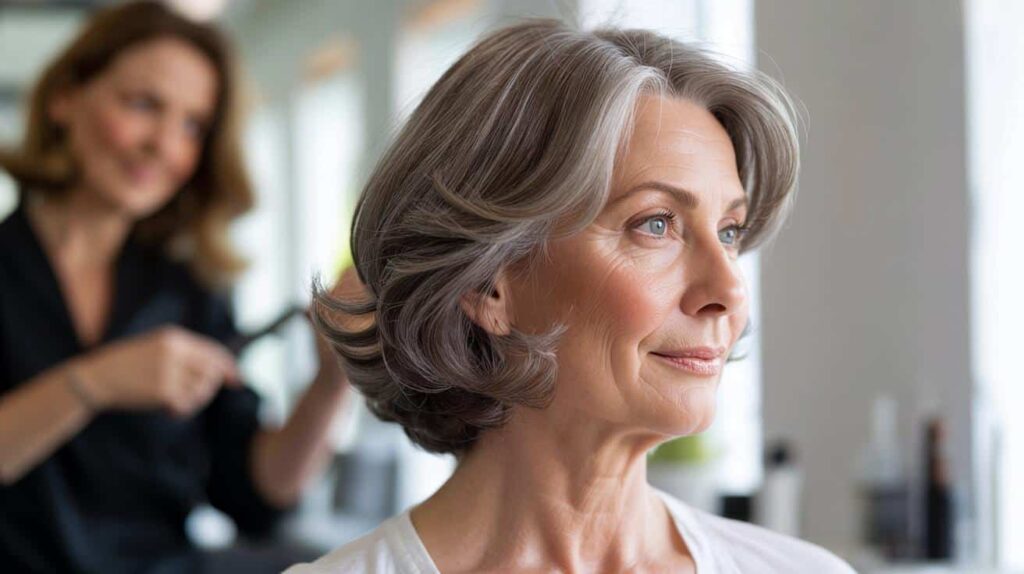
The stylist smooths the cape over her shoulders and studies her reflection in the mirror. “Same angled bob?” he asks, lifting his scissors.
The sharp line that once framed her face perfectly now feels different—flatter, stricter, and less forgiving. Over the years her hair has grown finer, especially at the crown. The once-full back now appears softer and less structured. What used to feel bold and sculpted now highlights the very things she would rather soften: reduced volume, a more delicate neckline, and facial features that have naturally evolved with time.
Why the Angled Bob Often Stops Working After 55
For years, the angled bob dominated salon trends worldwide. Its signature look—shorter at the back and longer toward the chin—creates a dramatic, polished shape with crisp lines.
This style works beautifully on thick, dense hair because the structure supports itself. The stacked layers at the back create a curved silhouette that appears sleek and sculpted.

But hair naturally changes after age 55.
- Hair density gradually decreases
- Individual strands become finer
- Volume at the crown often diminishes
When these changes occur, a sharply angled outline can start to look harsh instead of flattering. Rather than lifting the face, the downward angle may draw attention toward the jawline and neck.
The stacked back that once appeared full can also collapse slightly, creating a flatter shape instead of the intended sculpted effect.
The haircut itself isn’t the problem—the hair wearing it has simply changed.
The Softer Bob That Stylists Recommend Instead
Today many stylists recommend a softer, rounded version of the bob that maintains a similar length but removes harsh angles.
This updated shape typically sits between the ears and the middle of the neck. The back remains slightly shorter than the front, but the graduation is subtle rather than dramatic.
The real transformation happens inside the cut.
- Invisible internal layers at the crown add lift
- The perimeter is softly textured rather than sharply cut
- Volume is distributed higher toward the temples and crown
This shift in structure helps restore movement and balance to finer hair.
The overall result feels lighter and more natural. The jawline appears softer, the neckline looks relaxed, and the hair moves freely rather than holding a rigid shape.
Why This Cut Is Easier to Style
One major advantage of the softer modern bob is how easy it is to style.
Because the shape supports natural movement, it often looks good with minimal effort. Many people find they can simply rough-dry their hair with their fingers and a small amount of styling mousse.

Unlike the traditional angled bob, which often requires careful blow-drying to maintain its shape, this updated version works with the hair’s natural texture.
How to Ask for This Style at the Salon
Instead of simply requesting “a bob,” it helps to be specific about the details you want.
Consider discussing the following with your stylist:
- Ask for a rounded bob that skims the neck
- Request soft edges instead of sharp angles
- Ask for subtle internal layers at the crown to create lift
- Emphasize that you want movement and softness around the face
It can also be helpful to bring reference photos that match your hair type—fine, medium, thick, or naturally grey.
What to Avoid With Fine or Thinning Hair
Certain cutting techniques can unintentionally emphasize thinning areas.
Stylists often recommend avoiding:
- Heavy stacking at the nape, which can expose thinner sections
- Excessive razor cutting that weakens the ends
- Very short top layers that can stick up instead of creating fullness
The goal is to create softness and natural movement without over-complicating the structure.
Letting Go of a Long-Time Signature Style
Changing a haircut that you’ve worn for years can feel surprisingly emotional. A signature style often becomes part of personal identity.But updating a haircut isn’t about erasing the past—it’s about aligning your style with the present.
As hair texture and facial structure evolve, the most flattering cuts adapt with them.The softer, rounded bob works with today’s hair rather than trying to recreate a shape that once suited thicker density.
Many women say that once the sharp lines disappear, their face appears brighter and more relaxed. Friends may not even notice the haircut itself—they simply comment that you look refreshed.
Classic Angled Bob vs. Softer Modern Bob
| Feature | Classic Angled Bob | Softer Modern Bob | Benefit |
|---|---|---|---|
| Back Shape | Sharply stacked | Gently rounded | More natural volume distribution |
| Perimeter | Strict straight lines | Soft, lightly textured | Less emphasis on the jawline |
| Layer Placement | Minimal internal lift | Subtle crown layers | Creates gentle height and movement |
| Styling Needs | Frequent blow-drying | Easy air-dry or rough-dry styling | Lower maintenance |
| Overall Look | Structured and graphic | Airy and fluid | Softens facial features |
A Small Change That Makes a Big Difference
Sometimes the most powerful style update isn’t dramatic. A few centimeters of length, a softer line, or a hidden internal layer can transform how hair moves and frames the face.
When the shape begins working with your natural texture again, the haircut stops feeling rigid—and starts feeling effortless.

And often, that’s when it feels like yourself again.