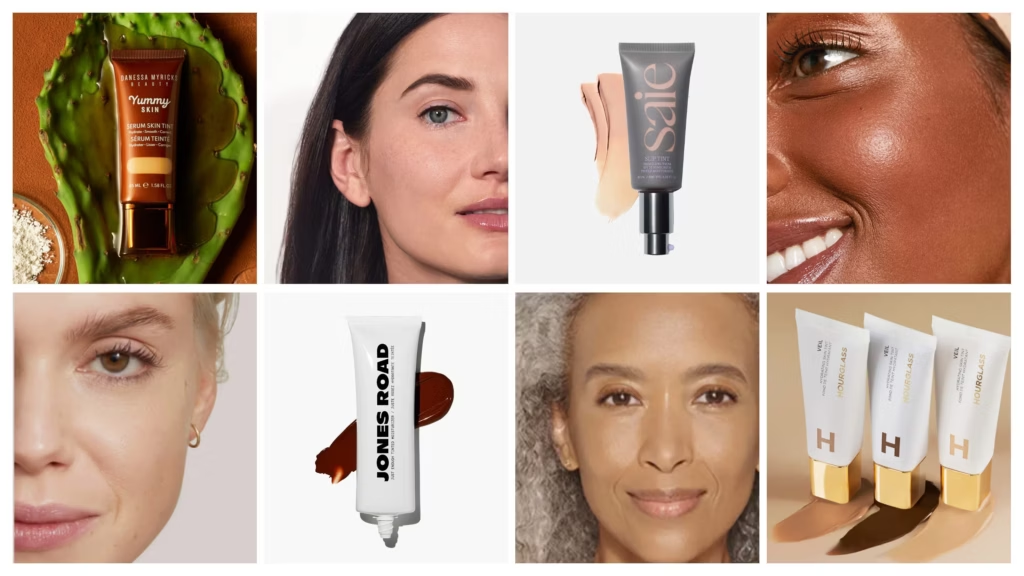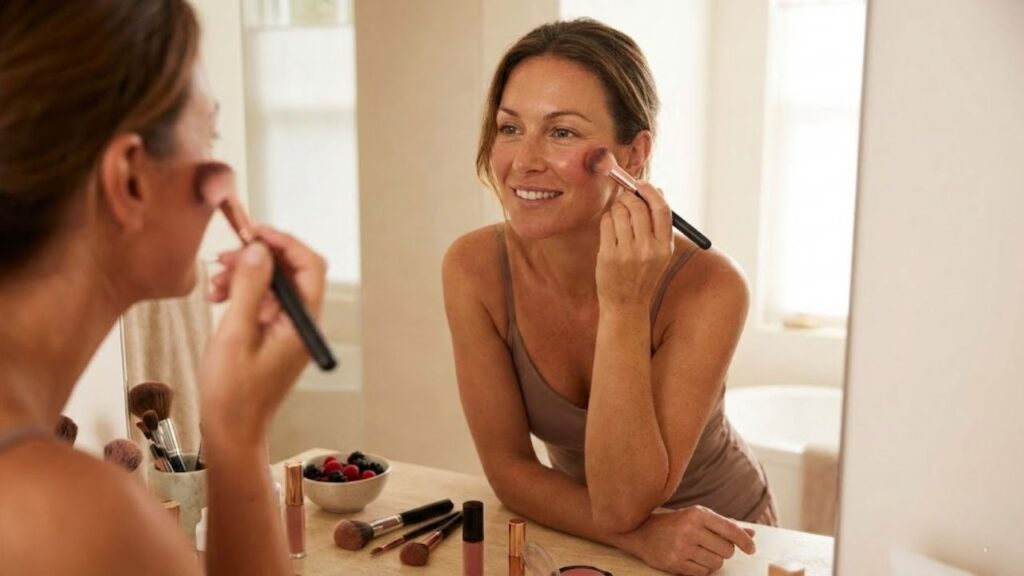
Looking in the bathroom mirror the woman looks almost exactly like she did when she was twenty-five Her cheeks are a little lower now. Her jawline now softly incorporates the rounded areas that used to lift when she smiled. She grabs her go-to blush brush and does what she always does, which is to smile and colour the apples of her cheeks Then she comes to a halt Her face appears drooping rather than lifted due to the colour The middle of her face appears somewhat swollen, and the shadows beneath her eyes seem darker. She takes off the blush and tries again positioning it a little higher this time Suddenly, her cheekbones appear more distinct Her eyes appear more awake and her whole face seems lifted She applied the same blush. She is the same individual. However, her face appears entirely different. The product remained unchanged. Where she applied it was different.
The Blush Placement Technique
There’s a strange age at which your makeup regimen becomes ineffective. It doesn’t happen at a specific time. When you use the same methods that have been effective for years, you simply start to wonder why things don’t look right anymore. Usually, blush is the first issue. Applying it low and round can make a thirty-two-year-old appear exhausted by late afternoon. The colour that was once attractive on the apples of your cheeks is now more closely associated with the delicate lines surrounding your mouth and nose It simply settles into those areas rather than adding shape. At that point it becomes more crucial to adjust the location of your blush than the type. I was informed by a London makeup artist that she can determine someone’s age by observing how they apply blush. Younger people place it like a simple drawing in the middle of their cheeks Even though their faces have slightly changed over time, people over 30 frequently continue to do this She mentioned that she was visited by two sisters, ages 28 and 38 Their skin tones were similar and they used the same products The younger sister’s entire face looked better due to the colour of her cheekbones. The older sister’s slight hollows under her eyes suddenly became more noticeable in that same spot The 38-year-old appeared to have slept through the entire night when the artist moved the blush closer to her temples. Her eyes and cheekbones were highlighted rather than the center of her face by the colour which functioned as a gentle filter Despite the fact that people rarely discuss it, the explanation for this is simple. Your bone structure remains unchanged after 30, but the fat beneath your skin begins to change Your cheek’s rounded portion descends. You can still follow where that round part used to be and smile thanks to your muscle memory. As a result, you end up applying colour to the area that is beginning to fade. Your face appears to be sagging when you apply blush there. Your face will appear lifted if you move it slightly up and out. In reality, you’re not altering your features. Simply put you’re altering the first thing that people notice about you. That’s why a tiny bit of pink blush works so well.
The Easy Blush Method That Still Works After 30
The makeup method that is currently so popular is surprisingly simple You should maintain a relaxed expression and look straight ahead rather than grinning and blushing your cheeks Imagine a diagonal line that extends from the side of your nostril to the top of your ear Blush should be applied along the upper portion of that hypothetical line nearer your ear than your nose It should resemble a gentle slanted C that curves in the direction of your eye’s outer corner. Instead of blending the colour down toward the middle of your cheek, blend it upward into your temples. Like watercolour on paper, let the colour gradually fade as it approaches your hairline This position instantly highlights cheekbones that most people over 30 may have forgotten they had. Another minor change has a discernible impact. Make sure there is a clear space between the area beneath your eyes and the beginning of the blush A finger-width of bare skin keeps colour from highlighting dark circles or settling into fine lines. You can add a small amount of blush to the bridge of your nose but keep the primary colour high and toward the outside of your face if you want to look freshly flushed. The same worry is shared by many adults over 30 They are concerned about appearing overdone but they want a healthy glow One heavy application applied too low on the cheek can make you appear unflatteringly flushed, so the concern makes sense. For this reason, the location of the blush is more important than its dosage. Use less product at first than you believe you’ll need. Rather than sweeping it over your skin, tap it on Instead of applying one thick stripe gradually increase the colour in thin layers Because cream blushes blend into the skin rather than sit on top of it, they frequently work better on mature skin. Let’s be truthful about the real world. In reality no one has twenty minutes to spare and professional brushes to do this every day. You may be using one hand to apply makeup and the other to check your phone. Therefore, choose one straightforward rule such as “higher and further back that you can recall on a hectic morning and disregard the others Additionally, the emotional impact is real That slightly higher placement can make your entire face appear more awake on a day when you’re exhausted All of a sudden, you appear to be the person you still feel like on the inside Important Things to Keep in Mind When applying blush along an upward diagonal imagine an angled line rather than a round spot. Avoid using the brightest colour near your mouth and nose. To give the outside of your face a lifting effect blend upward into your temples. If powder settles into the texture of your skin, go for cream or liquid formulas. Every few years, reevaluate where you apply blush because faces change and your routine should adapt accordingly.
 4 evening yoga poses designed to release tight hips and ease tension after long sedentary days
How Blush Turns Into a Subtle Age-Related Confidence Reset
Changing the way you apply a product you’ve been using for fifteen years has a subtle radical quality. It’s similar to acknowledging that your face has changed and choosing to work with it rather than against it. Over time, a single faint diagonal stripe turns into a tiny act of compromise. In the loo, friends complain about appearing worn out or unrecognisable. Frequently, it’s not their face that has undergone such a significant transformation, but rather the way light and shadow now traverse it. You can alter where the light appears to land by varying the splash of colour. The map you make on your skin changes the narrative your face conveys before you even speak, making it almost philosophical. Everybody has experienced the moment when they see their reflection in a shopfront window and wonder who it is. Although it can lessen the shock, remapping blush does not eliminate it. The proper placement gives the impression that you are still there. It doesn’t act like you’re twenty-two; instead, it accentuates the expression and structure you’ve earned without demeaning everything. This straightforward modification is also oddly shareable. It’s difficult not to show your mother or a friend the difference after you’ve tried the higher lifted placement. You wound up using one cheek the old way and one the new when performing that half-and-half trick. Generally speaking the contrast speaks louder than any instruction Blush becomes more about comprehending your own architecture and less about following trends. Where does your face appear instantly more awake and where does it want colour? Colour travelling upward tends to read as youth and energy, but there isn’t a universal diagram that works for everyone Fatigue is often indicated by colour that accumulates in the center. Perhaps this explains why, despite the fluctuations in contouring and highlighting, this technique continues to appear on social media It’s easy and doesn’t call for new products. You are merely shifting your current possessions a few millimetres to the north.